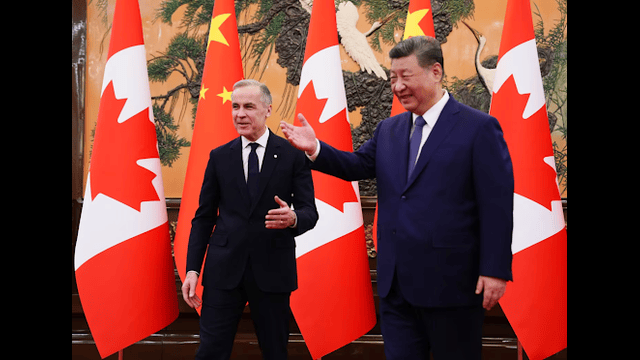
Prime Minister Mark Carney meets with President of China Xi Jinping at the Great Hall of the People in Beijing, China on Friday, Jan. 16, 2026. The Canadian Press
U.S. President Donald Trump has voiced support for a new Canada–China trade agreement, striking a notably different tone from members of his own administration earlier in the day.
Asked at the White House to respond to news that Prime Minister Mark Carney and Chinese President Xi Jinping had reached a trade understanding, Trump offered a blunt endorsement. If Canada can secure a deal with China, he said, it makes sense to do so.
His remarks appeared to soften earlier warnings from U.S. officials, who suggested Ottawa could regret the move.
Conflicting Messages from Washington
Just hours before Trump spoke, U.S. Trade Representative Jamieson Greer criticized the agreement, calling it problematic for Canada. Speaking to CNBC, Greer pointed to U.S. tariffs on Chinese vehicles as a way to protect American auto workers and questioned Canada’s decision to open its market.
The mixed messaging highlights ongoing divisions within Washington over how to approach trade with China, especially in the electric vehicle sector.
Trump himself has taken a more pragmatic stance in recent days. Speaking earlier this week at the Detroit Economic Club, he reiterated that Chinese automakers are welcome to invest in the U.S., as long as they build factories locally and hire American workers.
What Canada and China Agreed To
The deal emerged from Prime Minister Carney’s visit to Beijing, aimed at repairing strained relations and ending a long-running tariff dispute. Carney described the agreement as preliminary but landmark in scope.
At its core, the deal is a trade-off between agriculture and electric vehicles.
Canada will allow up to 49,000 Chinese-made electric vehicles into the country each year. Those imports will face a tariff of 6.1 per cent, sharply reduced from the current 100 per cent rate.
In return, China will roll back steep duties on several key Canadian agricultural exports.
Major Relief for Canadian Farmers
The changes are particularly significant for Canada’s farm sector. China has agreed to cut tariffs on Canadian canola seed to 15 per cent from rates as high as 84 per cent by March 1.
Tariffs imposed under China’s so-called anti-discrimination measures on canola meal, lobster, crabs, and peas will also be lifted from March through at least the end of the year. Canola oil, however, will remain subject to a 100 per cent tariff.
The agreement restores access to one of Canada’s most valuable export markets. China is the world’s largest buyer of peas and Canada’s second-largest canola customer after the United States.
Limited Opening for Chinese EVs
On the automotive side, Ottawa has stressed the limits built into the agreement. Carney said the 49,000-vehicle cap is close to pre-tariff import levels and would account for less than three per cent of Canada’s domestic auto market.
He added that by 2030, half of the imported vehicles are expected to be priced under $35,000, positioning the move as a way to improve affordability rather than flood the market.
Beyond trade, Carney framed the agreement as the start of a broader strategic reset. The two countries plan to expand tourism, strengthen cultural exchanges, and introduce visa-free travel for Canadians visiting China.
Political Reactions at Home
The deal has divided Canadian political leaders. Ontario Premier Doug Ford warned it could pose risks to domestic auto workers and manufacturing jobs.
Saskatchewan Premier Scott Moe, by contrast, welcomed the agreement, calling it a major win for exporters who rely heavily on access to the Chinese market.
With Trump now publicly backing Canada’s right to strike the deal, the agreement enters its next phase amid shifting geopolitical and economic calculations on both sides of the Pacific.