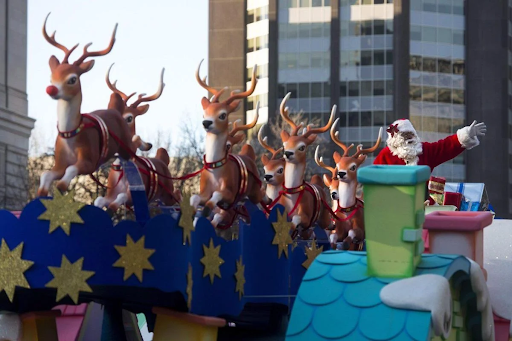
Santa Claus greets spectators from his float during the Santa Claus Parade in Toronto on Sunday, Nov. 15, 2015. THE CANADIAN PRESS
Canada says Santa Claus is officially a Canadian citizen and that his famous North Pole home and workshop fall under Canadian control. The claim adds a festive twist to a long-running debate over Arctic sovereignty. While the federal government granted Santa citizenship years ago, the international community has not settled who controls the North Pole.
Every year, more than a million letters arrive addressed to Santa Claus. Children send their wishes to what many believe is his Canadian home. The red-and-white colours on those envelopes may even seem fitting, given Canada’s national flag.
Canada’s Case for Santa’s Citizenship
Canada Post lists Santa’s address as the North Pole, Canada, using the postal code H0H 0H0. In 2008, the federal government formally declared Santa a Canadian citizen. At the time, then citizenship minister Jason Kenney made the announcement during the holiday season.
“The government of Canada wishes Santa the very best in his Christmas Eve duties and wants to let him know that, as a Canadian citizen, he has the automatic right to re-enter Canada once his trip around the world is complete,” Kenney said.
Two years later, Kenney again confirmed Santa’s status and said he took part in a special citizenship ceremony alongside 100 other new Canadians. Officials also spoke about Canada’s plans to strengthen its presence in the North. In 2013, Canada issued electronic passports to Santa and Mrs. Claus, saying the couple planned a vacation after Christmas.
The Arctic Sovereignty Question
Canada’s claim over Santa’s home ties closely to its Arctic policy. In 2008, the federal government expanded its definition of Arctic waters, extending protection and oversight farther from shore. The move aimed to guard against pollution but also strengthened Canada’s claim to northern waters.
Canada states that its Arctic sovereignty covers land, sea, and ice, including the islands of the Arctic Archipelago and the Northwest Passage. According to federal policy documents, this claim reaches beyond the coastlines of the northern islands.
However, international law complicates the picture. No country officially owns the North Pole. Global rules allow Arctic nations to control waters within 200 nautical miles of their coasts. Countries may also claim more territory if they prove their continental shelf extends farther underwater.
In recent years, Canada asked the United Nations to recognize an extended continental shelf that includes an undersea ridge reaching the North Pole. Russia and Denmark have made similar claims. The United Nations has not ruled on any of them, leaving the North Pole in international waters for now.
Other Countries Make Their Own Claims
Canada is not alone in laying claim to Santa. Finland promotes the city of Rovaniemi as Santa’s official hometown and says his main office operates there. Denmark and Greenland point to the town of Uummannaq, which features a large red mailbox for Santa’s letters.
The historical figure believed to inspire Santa lived in what is now Turkey, adding another layer to the debate.
Christmas Carries On
Despite disagreements over citizenship and geography, Santa’s annual journey does not appear at risk. As Dec. 24 approaches, children around the world can still expect gifts, no matter which country claims his address.