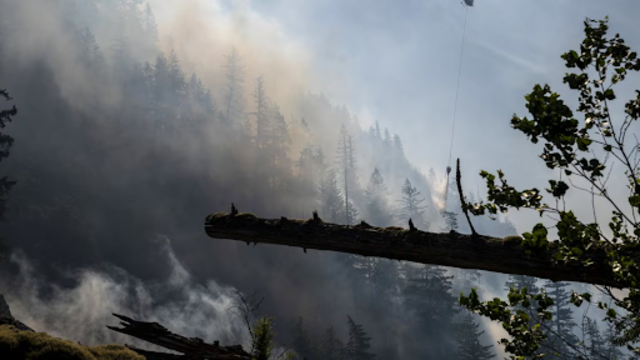
Aerial firefighters battle the Dryden Creek wildfire north of Squamish, B.C., on June 11, 2025. THE CANADIAN PRESS
Canada’s goal to cut greenhouse gas emissions by 40 to 45 per cent by 2030 is no longer realistic. A new report from a top climate research group shows emissions stayed the same in 2024, meaning Canada is far from meeting its target.
Emissions Remain High Despite Efforts
The Canadian Climate Institute reported that emissions in 2024 totaled 694 million tonnes. That’s the same as in 2023, equivalent to the pollution caused by 146 million gas-powered cars in a year.
While some sectors like electricity and heavy industry lowered their emissions, the oil and gas sector saw an increase. This rise offset any gains made elsewhere.
Canada promised to cut emissions almost in half compared to 2005 levels by 2030. Right now, emissions are only about 8.5 per cent lower than in 2005. To meet the target, Canada must reduce emissions by 40 million tonnes every year—something experts say is impossible at this point.
Dave Sawyer, an economist with the Canadian Climate Institute, said, “It really is a combination of time left (and) technical feasibility. Rolling out the scale of emission reductions required to close that gap is massive.”
He added, “It’s a challenge when you’ve got emissions growing as we do, especially in the oil and gas sector. That’s the bottom line.”
Canada Trails Behind in Global Efforts
Canada’s struggle to meet its target is no surprise. The country is the worst performer in the G7 for cutting emissions. A year ago, Environment Commissioner Jerry DeMarco warned Canada would miss the target. He said Canada still has 20 to 30 years of work ahead to catch up.
The Climate Institute’s report estimates Canada is only on track to reduce emissions by 20 to 25 per cent compared to 2005 levels. The group calls Canada’s progress “fragile.”
Sawyer said, “Momentum is going in the wrong way. Most other sectors are either flat or stalled, maybe declining slightly. But the upward pressure from oilsands is driving emissions up, and methane reductions aren’t happening fast enough.”
In 2024, emissions from oil and gas rose by 1.9 per cent, making up almost a third of all emissions. Transportation emissions stayed steady and make up 23 per cent. Emissions from buildings, heavy industry, and electricity all dropped slightly.
Policy Changes Impact Progress
Sawyer points to recent federal and provincial policy changes as reasons for slower emissions reductions. Policies now focus more on economic growth than cutting emissions.
Examples include the repeal of the consumer carbon price and pausing the electric vehicle mandate by Prime Minister Mark Carney’s government. Saskatchewan plans to keep its coal plants running longer, and Alberta froze its industrial carbon pricing for 2026.
“These changes all mean fewer emission cuts or even rising emissions in the future,” Sawyer said.
Carney and his ministers have not confirmed if Canada still aims to meet its 2030 or 2035 targets. However, they say the government remains committed to reaching net-zero emissions by 2050.