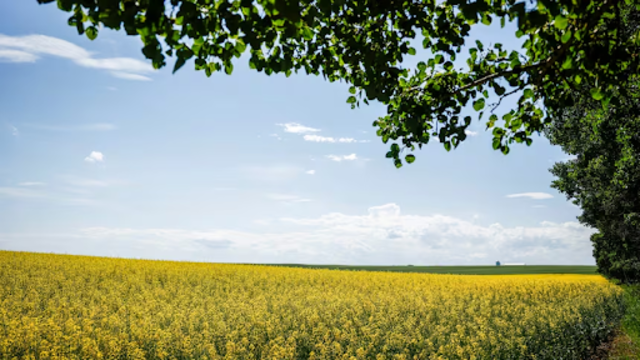
Canola fields near Cremona, Alta. China recently launched an anti-dumping probe into Canadian canola, following Canada’s tariff hike on Chinese EVs. Image Credit: The Canadian Press.
Manitoba Premier Wab Kinew has warned that Canada’s tariffs on Chinese electric vehicles are deepening economic pain across Western Canada. In a letter to Deputy Prime Minister Mark Carney on Saturday, Kinew said the policy has triggered a “two-front trade war” that is hitting Prairie canola and pork producers hard.
Kinew emphasized that while protecting Canada’s auto industry is important, the federal government’s strategy is hurting other key sectors. “China’s retaliatory tariffs have already caused a sharp drop in canola prices,” he wrote, adding that one Manitoba-based pork producer is facing losses of about $19 million annually.
Growing Trade Fallout
Canada introduced its 100 per cent tariff on Chinese-made electric vehicles last year, mirroring a similar move by the United States. The measure, Ottawa said, was meant to protect the domestic automobile industry from unfair competition, arguing that China heavily subsidizes its EV manufacturers.
However, Beijing responded swiftly. China imposed steep duties on Canadian canola, pork, and seafood, dealing a heavy blow to Western Canada’s export-driven economy. China’s current tariffs include a 76 per cent levy on canola seed imports, 100 per cent on canola oil and meal, and 25 per cent on certain pork and seafood products.
The impact has been severe. Saskatchewan’s canola exports to China plunged 76 per cent in August compared to the same month last year, falling to just $96 million. “Every day these tariffs stay in place, Prairie producers lose more,” Kinew warned.
Political Divide Over Trade Strategy
Saskatchewan Premier Scott Moe previously urged Ottawa to reconsider the EV tariffs, but only if Canada’s relations with the U.S. remain unaffected. Moe has since acknowledged that lifting the tariffs would be a complex process.
Meanwhile, Ontario Premier Doug Ford has taken a different stance. In a letter to Carney last month, Ford backed maintaining the 100 per cent tariff, stressing the need to safeguard Ontario’s auto sector and strengthen trade ties with Washington.
Ford’s statement, however, did not address the repercussions of China’s retaliatory measures on Western farmers.
A Diplomatic Opening
The Chinese ambassador to Canada, Wang Di, suggested recently that Beijing is open to negotiations. In an interview aired Sunday, Wang said China could lift its tariffs on canola and pork if Canada removes the EV duty.
Calling this a “critical moment,” Kinew urged Ottawa to “seize the opportunity” and restore market access for Prairie producers.
In an opinion piece posted on the Chinese embassy’s website, Wang argued that Canada’s EV tariff violates World Trade Organization rules. Lifting it, he said, would help Canada “reaffirm its image as a supporter of a rules-based global trading system.”
Ottawa Reviewing Policy
The federal government has confirmed that it is reviewing the EV tariff decision but has not disclosed when the review began or when it might conclude. The tariffs, which took effect on October 1, 2024, were meant to be reassessed within a year of implementation.
For now, the tension continues — a balancing act between industrial protection in Ontario and economic pain on the Prairies, leaving Canada caught between two fronts of a trade dispute that shows no sign of easing.