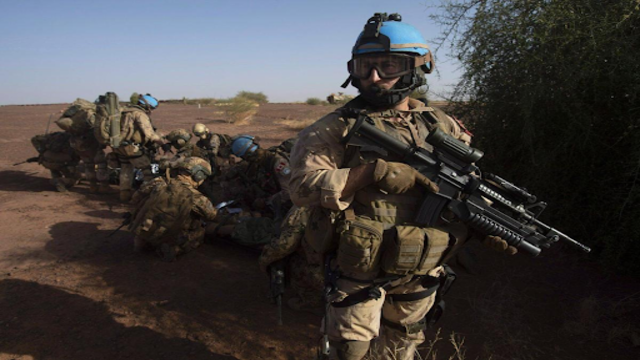
A Canadian Armed Forces member stands guard while medics help German soldiers during a medical evacuation drill at the United Nations base in Gao, Mali, on Saturday, December 22, 2018. (File photo, The Canadian Press)
Canada now has only two female soldiers serving in United Nations peacekeeping missions. The sharp decline has raised concerns that Canada is falling behind on its promises to support women in global peace efforts. Critics warn the country could face embarrassment on the world stage for not meeting international targets.
The latest UN data released in May showed just 29 Canadians serving in 11 missions. That group included 18 military staff officers, six police officers, and five experts. None of the 18 military officers were women, even though UN rules expect at least 22 per cent of them to be female. Only three of the six police officers were women.
Canada’s earlier promises
Back in 2017, then-prime minister Justin Trudeau pledged to make Canada a global leader in promoting women in peacekeeping. His government tied this to its feminist foreign policy and launched the Elsie Initiative, a program to boost women’s involvement in UN operations. At the time, Canada appeared ready to lead.
During the mission in Mali from 2018 to 2023, women made up about 25 per cent of Canadian soldiers deployed. But since then, numbers have steadily dropped. When Trudeau left office earlier this year, only one female soldier was serving in UN peacekeeping.
Experts raise alarms
Walter Dorn, a professor at the Royal Military College of Canada, said the decline shows Canada has let its promises slide. He warned that missing targets could damage Canada’s image and risk losing influence in UN decision-making.
“This is embarrassing in the international community,” Dorn said. “The UN will flag Canada for not meeting the standards we supported.”
Jane Boulden, another professor at the same college, said the world has shifted since the 1990s when Canada ranked among the top UN contributors. She noted that Canada now focuses on NATO commitments, including the 1,900 soldiers deployed in Latvia after Russia’s invasion of Ukraine.
“Once troops went to Latvia, the idea of sending numbers to UN operations was gone,” she said.
Government responds
The Department of National Defence said numbers change often and that six Canadian women are currently serving in peace operations, including two soldiers in the Middle East and South Sudan and four police officers in Congo.
“Canada continues to champion the meaningful participation of women not only in UN peacekeeping, but also in other organizations such as NATO,” spokesperson Kened Sadiku said.
Still, critics say Canada’s contributions remain far below past levels. In 1993, more than 3,300 Canadians served in UN peacekeeping. Today, Canada ranks 74th in personnel contributions.
Past glory, present decline
Retired Brig.-Gen. Gregory Mitchell said peacekeeping lost importance after the missions in Bosnia and Somalia during the 1990s. He added that many leaders shifted focus during the Afghanistan war, favouring combat over peacekeeping.
“Peacekeeping is not what we should be doing, they believed,” Mitchell said.
For many observers, Canada’s record low female presence highlights a deeper truth: the country’s peacekeeping role is no longer what it once was.