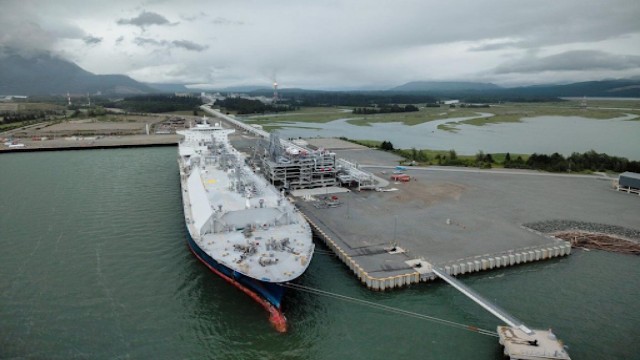
A tanker is seen being loaded with Canada’s first shipment of liquefied natural gas at the Kitimat port in British Columbia on Saturday, June 28, 2025. The photo was shared by LNG Canada. (Credit: The Canadian Press/Handout — LNG Canada)
In a major turning point for Canada's energy sector, the country has officially sent its first shipment of liquefied natural gas (LNG) overseas. The GasLog Glasgow, a specialized LNG tanker, has left the northern British Columbia port of Kitimat and is now en route to Asia. This event marks the beginning of Canada’s long-awaited entry into the global LNG market.
Chris Cooper, CEO of LNG Canada, called it a “historic moment” as the shipment symbolizes Canada’s shift toward becoming a global energy player, no longer solely dependent on the United States for gas exports. Until now, Canadian natural gas has been exported exclusively through pipelines to its southern neighbour.
The LNG Canada facility in Kitimat is the heart of this transformation. Although the project's full cost hasn’t been publicly confirmed, the federal government has described it as the most significant private investment in Canadian history, estimated at $40 billion. The project spans three major components: the gas fields in northeastern B.C., the Coastal GasLink pipeline built by TC Energy, and the Kitimat liquefaction terminal.
This massive undertaking is a joint venture among global energy giants, including Shell, Petronas (Malaysia), PetroChina, Japan’s Mitsubishi Corporation, and South Korea’s KOGAS.
Prime Minister Mark Carney praised the launch, highlighting it as a step toward cleaner global energy, stronger trade partnerships, and recognition of Indigenous collaboration. “Canada has what the world needs,” he stated in a release. “This shipment proves our ability to deliver responsibly produced energy to trusted global partners.”
During construction, around 50,000 Canadians worked on the LNG terminal, and another 25,000 were involved in building the pipeline. LNG Canada noted that over $5.8 billion in contracts were awarded—most going to Indigenous-owned or local companies. More than 300 permanent jobs have also been created in Kitimat.
The project’s first phase will export 14 million tonnes of LNG annually, with the potential to double if Phase 2 proceeds. Cooper emphasized that a second phase will require careful evaluation of policies, costs, and environmental responsibilities.
LNG, or liquefied natural gas, is regular natural gas cooled to -162°C, which transforms it into a liquid for easier transportation overseas. Canada’s ability to now ship LNG opens new possibilities in the face of global uncertainties and rising demand for stable energy supplies.
British Columbia Premier David Eby stressed the need for Canada to reduce its economic reliance on the United States. “Projects like this are key to making B.C. the driving force behind a stronger, more independent Canada,” he said.
TC Energy CEO François Poirier pointed out that although Canada and the U.S. began developing LNG simultaneously, the U.S. became the world’s largest exporter much faster. Canada is now catching up, with hopes of contributing to energy security across North America.
Other LNG projects are also gaining momentum in B.C., including Cedar LNG, Woodfibre LNG near Squamish, and the proposed Ksi Lisims project near Prince Rupert. While some of these await final investment decisions, LNG Canada is already reshaping Kitimat’s landscape.
Residents may notice ongoing flaring as the plant moves into regular operations. Mayor Phil Germuth noted that despite minor disruptions, most locals are supportive, recognizing the long-term benefits.
However, not everyone is celebrating. Environmental advocates argue LNG is not as clean as it seems. Critics point out that methane, a component of natural gas, is a potent greenhouse gas. Campaigners like Anna Barford from Stand. Earth believe Canada should prioritize renewable energy over expanding fossil fuel infrastructure.
Even as debate continues, Canada’s first LNG shipment is now a reality, putting the country on a new energy path—one that balances economic promise with global environmental responsibility.