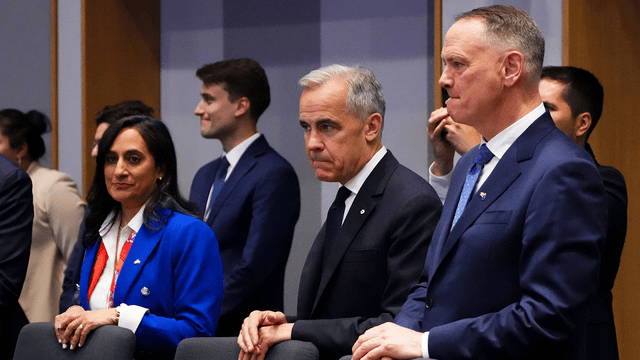
Prime Minister Mark Carney stood alongside Foreign Affairs Minister Anita Anand and Defence Minister David McGuinty as they waited for the Canada-EU Summit to begin in Brussels, Belgium, on Monday, June 23, 2025. The Canadian Press
Canadian Prime Minister Mark Carney says the country will boost its NATO spending by mining critical minerals and building related infrastructure. He shared these plans ahead of the NATO leaders’ summit in The Hague, Netherlands. Carney expects NATO allies to agree on raising defence spending to 3.5% of GDP within ten years.
What NATO Wants
NATO Secretary-General Mark Rutte wants to nearly double the current defence target. He wants 3.5% of GDP spent on core defence items, and an extra 1.5% on support areas like infrastructure and cyber. Carney notes this would mean Canada would spend around $150 billion a year if it reaches 5% of its GDP—up from $41 billion last year.
Minerals and Infrastructure Contribution
Carney says Canada will count mining critical minerals and building infrastructure toward its NATO targets. “Some of this spending counts towards that five per cent,” he explained. He described projects like ports and railways to ship minerals as part of Canada’s NATO duties and economic growth.
Critical minerals include lithium, nickel, and cadmium. NATO listed 12 minerals in 2024 as essential for defence, such as aluminum for aircraft bodies, graphite for tanks, and cobalt for engines. Canada has large deposits of these minerals and can offer vital resources.
Ottawa's Team Shares View
Foreign Affairs Minister Anita Anand said Canada supports increased defence spending but wants clarity on the timeline. Allies suggest hitting new NATO targets by 2029, a timeline Anand said needs flexibility. She wants check points along the way to see if the plan works.
Allies Still Divided
All 32 NATO members must agree on the new targets. Right now, no member spends as much as 5% of GDP. The U.S. led last year with 3.38%. The UK, France, Germany, and the Netherlands agree on the 5% goal, along with countries near Ukraine and Russia.
Spain and Slovakia oppose it. Spain secured an agreement to stay out of the 5% plan. Slovakia’s Prime Minister Robert Fico called the goal “absurd” and suggested neutrality instead. Rutte warned no member can opt out and that progress will be reviewed in four years.
Historical Context for Canada
Canada hasn’t spent 5% of GDP on defence since the 1950s. It hasn’t reached 2% since 1990. In 2024, defence spending amounted to 1.37% of GDP. Canada plans to hit 2% by 2032, but Carney recently said it will happen this year thanks to the new investments.
Carney also announced a new defence deal with the European Union, opening doors for defence sales and joint projects. Anand noted this pact helps grow Canada’s defence industry.
Geopolitical Moment
Observers say the summit comes at a crucial time. Questions linger about the U.S. commitment to defending Europe. Ongoing tensions between Russia and Ukraine remain. Ongoing trade disputes between North America and Europe also add to the strain.
Summary (60 words):
Canada will raise its NATO defence spending by mining critical minerals and building support infrastructure. Prime Minister Carney aims to meet a proposed target of 3.5% of GDP in ten years, with plans counting investments in ports and railways. While some NATO members resist, Canada supports the move, citing economic growth, shared European partnerships, and national security.