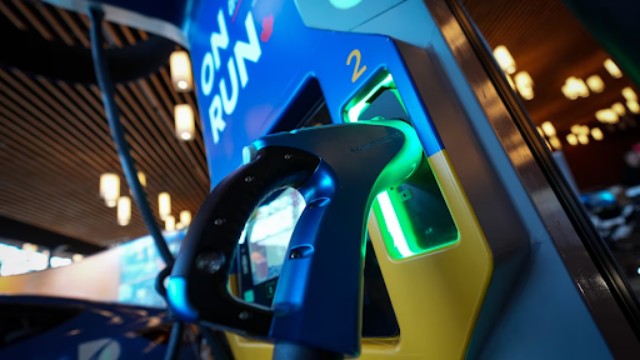
A DC fast charger made by Sumitomo Electric was displayed at the Fully Charged Live event—an exhibition focused on electric vehicles, clean energy, and urban transportation—held in Vancouver, B.C. (Photo: Darryl Dyck, The Canadian Press)
Canada is struggling to keep pace with the electric vehicle (EV) revolution. Despite growing interest in EVs and more chargers along major highways, the country remains far behind in building a complete and accessible EV charging network, experts say.
Right now, Canada has just over 35,000 EV charging ports. But according to Dunsky Energy and Climate, a Montreal-based consultancy, the country needs nearly three times more — 100,520 — to meet federal policy targets. That gap is widening, even as the demand for EVs grows.
Back in 2021, Dunsky's analysis, commissioned by Natural Resources Canada, estimated the country would need around 52,000 chargers by 2025. But a more recent study in February 2024 pushed that target higher, accounting for commercial fleets, multi-family homes, and less-travelled routes that also need charging infrastructure.
At the moment, most of Canada's chargers are heavily concentrated in three provinces: British Columbia, Ontario, and Quebec. In fact, 88% of all ports are located in these areas, which also happen to lead EV sales nationally. This leaves drivers in other provinces with few options, especially those who can’t install home chargers.
Jeff Turner, Director of Mobility at Dunsky, highlighted how this uneven growth puts certain Canadians at a disadvantage. “We’ve got to make this transition fair,” he said. “People in apartment buildings or those without driveways need real solutions.”
Turner also emphasized the need for charging options for street-parked vehicles. Without convenient access to charging, many urban EV owners feel left out of the green transition.
Last year, the federal government invited proposals for new public and private EV charging stations. Turner expects construction funded by these proposals to begin after summer, providing a much-needed boost to the current network.
However, the wait for new stations continues, especially for rural or underserved communities. Turner called this a “waiting period,” as Canadians anticipate visible progress.
Despite the hurdles, Turner noted improvements along popular highway corridors, especially between Toronto and the Atlantic provinces. These improvements have made longer road trips more manageable for EV users.
“People often see long drives as a dealbreaker,” Turner said. “But we’re now at a point where many EVs can recharge to 80% in around 30 minutes. Some of the best models do it in under 20.”
Beginning next year, Ottawa will enforce a new rule: 20% of new light-duty vehicles sold in Canada must be zero-emission, including plug-in hybrids. This target will grow yearly, reaching 100% by 2035.
However, this mandate is facing backlash. Automakers argue the target is unrealistic and may force them to stop selling gas-powered vehicles prematurely, which could disrupt local auto production.
But even if the policy changes, Turner stressed that the need for more charging stations remains. Whether EV adoption speeds up or slows down, people need reliable and conveniently spaced chargers to keep moving.
“It’s not just about how many EVs are sold,” he said. “It’s about making sure Canadians can drive where they want, when they want, without worrying about running out of power.”