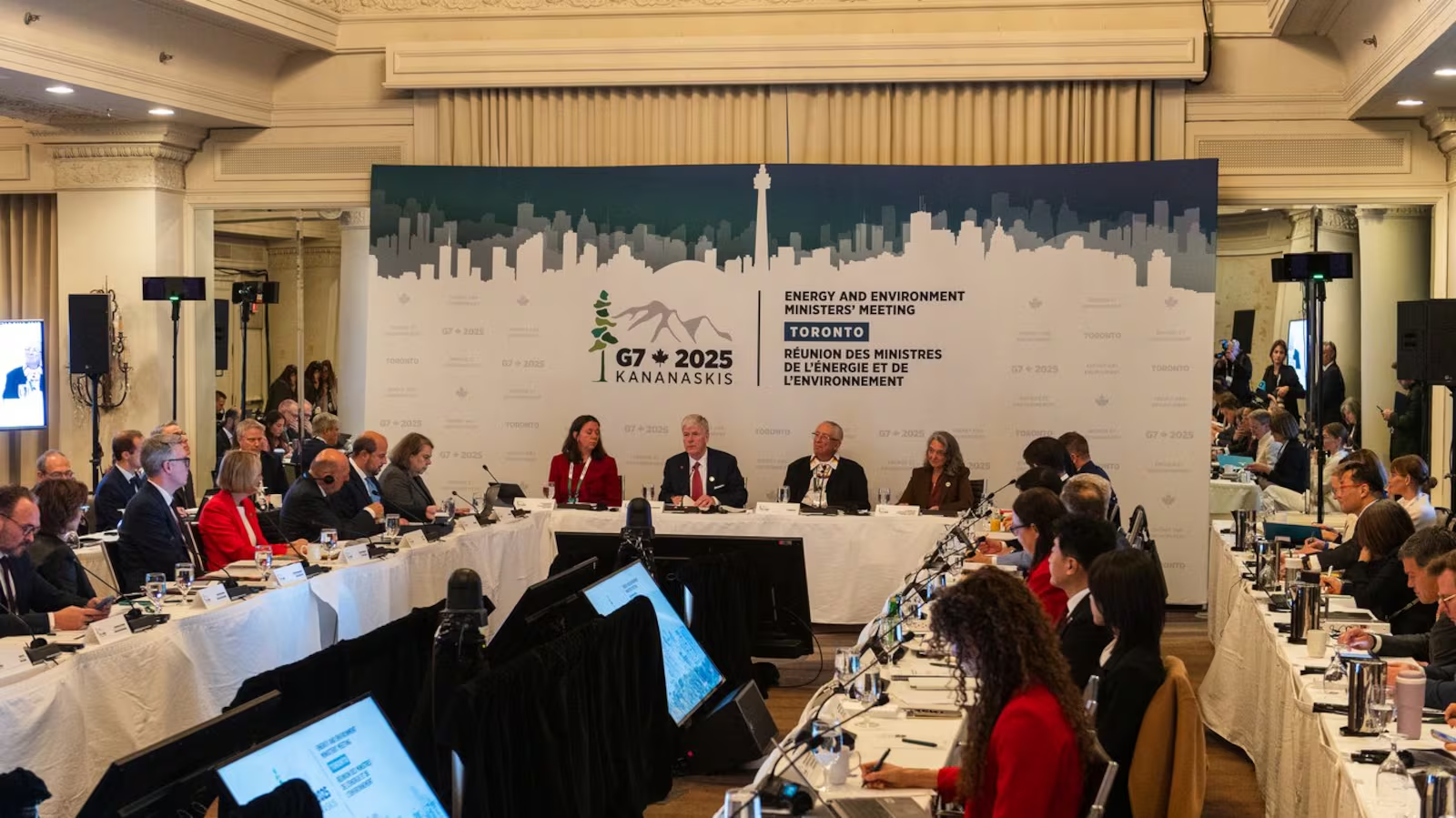
Officials, including Energy Minister Tim Hodgson and Environment Minister Julie Dabrusin, attend the G7 Energy and Environment Ministers’ Meeting Toronto on October 30, 2025. The Canadiain n Press
Canada has announced the first wave of investments under a G7 alliance aimed at reshaping the global critical minerals market and reducing dependence on China’s supply chains.
The federal government revealed 25 new initiatives, including purchase deals for a graphite mine in Quebec and funding to expand a rare earth refinery in Ontario. The move signals the G7’s growing resolve to strengthen supply resilience and national security amid China’s dominance in mineral refining.
A Push to Break Supply Dependence
Energy and Natural Resources Minister Tim Hodgson said the alliance’s first projects mark a crucial step toward economic independence.
“As we move swiftly to reduce dependence on concentrated supply chains, our collective commitment is clear,” Hodgson said. “Every delay is a concession of economic and national security interests. We will no longer accept that.”
China currently leads the world in mining and refining critical minerals, controlling about 70% of production for 19 of 20 key materials, according to the International Energy Agency. Its grip is even tighter in rare earth refining — essential for magnets used in electric vehicles and radar systems — where it accounts for 91% of global output.
China’s Control Spurs Global Action
In recent months, Beijing has leveraged its dominance by tightening export restrictions on several minerals, intensifying pressure on G7 nations to diversify their supply networks. The issue topped discussions at this week’s G7 meetings in Toronto, where ministers worked on strategies to secure alternative sources.
A temporary easing came on Thursday when China and the U.S. agreed to suspend certain export controls for one year. But American officials emphasized that the move only reinforces the urgency of building self-reliant mineral industries within the G7.
“China used non-market practices to push the rest of the world out of manufacturing these strategic materials,” said U.S. Energy Secretary Chris Wright. “Everyone sees that now.”
Key Canadian Projects Take Shape
Among the newly announced investments are offtake agreements for Nouveau Monde Graphite’s Matawinie mine near Montreal. The federal government, Panasonic, and Luxembourg-based Traxys have signed deals to purchase part of the mine’s future output.
Canada also pledged up to $500 million in financing through Export Development Canada to support a synthetic graphite plant planned by Norwegian company Vianode in St. Thomas, Ontario. Earlier this year, Vianode signed a multibillion-dollar supply agreement with General Motors for electric vehicle batteries.
Graphite plays a crucial role in lithium-ion batteries that power EVs and energy storage systems — key components of the global clean energy transition.
Another project, Ucore Rare Metals’ facility in Kingston, Ontario, received conditional approval for up to $36 million in federal funding. The investment will help scale processing of samarium and gadolinium, rare earth elements used in nuclear reactors, heat-resistant magnets, and MRI machines.
A Growing Demand for Critical Resources
Experts warn that global demand for minerals vital to decarbonization is set to surge. The Canadian Climate Institute estimates that domestic demand alone could require about $30 billion in new investments by 2040.
Wolfgang Alschner, a University of Ottawa professor who studies Canada’s minerals strategy, said the government has positioned itself effectively in this week’s G7 discussions. However, he noted that much of the focus remains project-based rather than policy-driven.
“Canada has clearly placed itself at the centre of the minerals conversation,” Alschner said. “But much policy work remains — especially around creating clear market standards.”
With these first steps, Canada aims to solidify its role in the global critical minerals landscape, ensuring both economic security and a stronger foothold in the clean energy future.