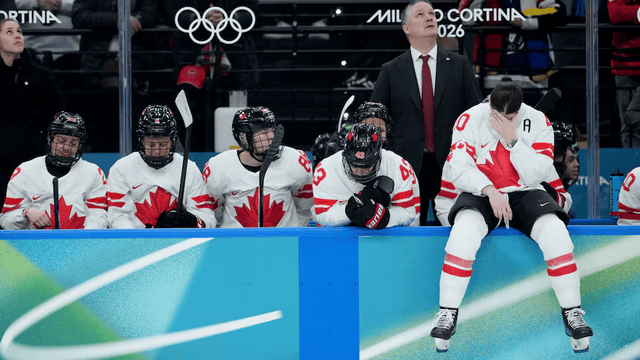
Canada lost in overtime, 2-1, to the Americans in the Olympic gold-medal game, but kept up the fight all game long.
Canada’s women’s team entered the Olympic final surrounded by doubt, yet determined to challenge their fiercest rivals.
Many expected a comfortable American victory, especially after repeated Canadian losses earlier this season.
However, the gold-medal clash quickly turned into a tense battle shaped by resilience, discipline, and emotional intensity.
Underdog Tag Followed Canada Into the Final
The United States arrived with dominant tournament numbers and overwhelming scoring power across a young, explosive roster.
They had also crushed Canada 5-0 in the preliminary round, reinforcing their clear favourite status.
Meanwhile, Canada carried the burden of seven straight defeats against their longtime rivals.
Captain Marie-Philip Poulin admitted the outside noise followed the squad everywhere.
Critics questioned the team’s age, tactics, and ability to match the American pace.
Still, the players focused on one performance rather than past results.
Defensive Grit Gives Canada Early Control
Canada opened the final with aggressive forechecking and tight defensive coverage across all three zones.
Their effort paid off when Kristin O'Neill scored a shorthanded goal after a fast transition rush.
The strike stunned the Americans and handed Canada a crucial 1-0 advantage.
O’Neill’s moment carried extra meaning after missing Olympic selection four years earlier.
She had travelled as a reserve in Beijing but never played a single shift.
This time, she delivered on the sport’s biggest stage through relentless work and determination.
Goaltending and Discipline Keep Canada Ahead
Canada’s defensive system required patience, sacrifice, and constant shot blocking under heavy pressure.
Goaltender Ann-Renée Desbiens anchored that effort with 31 crucial saves.
Her calm positioning helped Canada protect its narrow lead deep into the third period.
The team knew a high-scoring race would favour the Americans.
Instead, they chose structured hockey, quick clears, and disciplined line changes.
That grinding approach nearly carried them all the way to Olympic gold.
Veteran American Captain Forces Overtime
With minutes remaining, the United States pulled its goaltender for an extra attacker.
Captain Hilary Knight positioned herself directly in front of the net.
She redirected a puck past Desbiens to tie the game late.
The equaliser shifted momentum instantly and sent the packed arena into overtime suspense.
Canada regrouped quickly and created several dangerous three-on-three chances.
Yet every attempt slid wide or stopped inches from the winning goal.
Overtime Strike Ends Canada Women’s Hockey Olympic Final
Less than five minutes into overtime, defender Megan Keller fired the decisive shot.
Her goal sealed the American victory and ended Canada’s dramatic Olympic push.
Canadian players dropped to the ice, exhausted after one of their strongest performances all season.
Forward Laura Stacey later described the loss as painful but fiercely fought.
She said every teammate sacrificed everything for the person beside them.
Poulin, visibly emotional, said she remained deeply proud of the group’s effort.
A Team Bound by Trust and Shared Purpose
Throughout the tournament, players wrote a simple mantra on their stick tape.
It read: “Her first. Your last. Our best.”
The message symbolised the mix of Olympic rookies and longtime veterans.
Poulin quietly battled a knee injury during the competition yet never complained publicly.
She refused to distract teammates while chasing one final Olympic memory together.
That unity became the emotional backbone of Canada’s campaign.
End of an Era, Beginning of Transition
After the final buzzer, Poulin embraced teammates one by one along the bench.
Many veterans have competed together for more than a decade internationally.
Some may never again wear the Canadian jersey at another Olympic tournament.
Head coach Troy Ryan later praised the team’s trust and leadership culture.
He said their commitment reshaped both the program and his own coaching career.
Future squads will introduce younger players as the program gradually evolves.
For now, Canada leaves the Canada women’s hockey Olympic final with silver medals and lasting pride.
The story may not include gold, yet their relentless performance proved they never stopped believing.