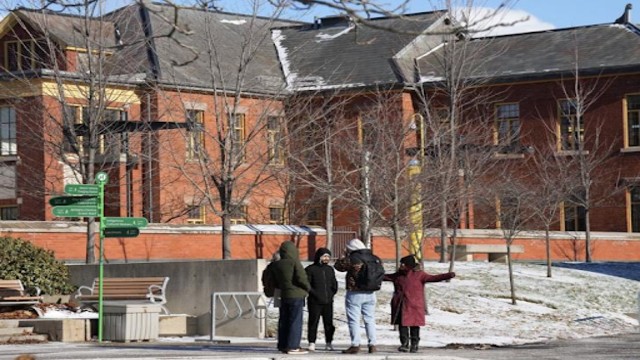
Students walk on Campus at the Humber College Lakeshore Campus in Toronto on Thursday, Dec. 11, 2025. The Canadian Press
Bhavik Sharma once pictured adulthood as stable and predictable. A good job. A home. Financial comfort by 25. Like many young Canadians, that vision no longer fits reality.
At 27, Sharma lives with his parents in Kitchener after leaving Toronto’s soaring rents behind. Saving for a home feels distant. Daily costs feel heavier. He sees adulthood arriving later, and at a higher price.
Researchers say Sharma’s experience reflects a deeper national shift. Canada’s young adults are reassessing what happiness looks like, and when it can realistically arrive.
Recent data shows a sharp emotional downturn. Canadians under 30, once the country’s happiest age group, now rank as the unhappiest.
A Dramatic Slide in Happiness
The World Happiness Report tracks how people rate their lives on a scale from zero to ten. In 2011, young Canadians ranked highest among all age groups. By 2024, they ranked lowest.
Among 134 countries, Canada recorded one of the steepest youth happiness declines. Only four nations showed worse drops.
This shift stands out because Canada still performs well overall. The country ranked 15th happiest globally in 2024. In 2025, it placed 18th. The national average hides deep generational divides.
Researchers say expectations play a major role. Young adults compare their present lives to an ideal future that now feels unreachable.

Bhavik Sharma
The Old Life Script Is Fading
Past generations followed a clearer path. Education led to jobs. Jobs led to homes. Families followed soon after.
Today, that timeline has stretched. Housing costs have surged. Job stability feels fragile. Savings grow slowly.
Canada’s housing affordability index hit its worst level in four decades in 2023. It has eased slightly, but pressures remain intense.
In 1986, young adults needed five years to save a home down payment. By 2021, that jumped to 17 years nationally. In Toronto and Vancouver, it reached 27.
Marriage and parenthood have also shifted later. The average age of marriage rose from 25 in 1968 to 35 by 2019. First-time motherhood climbed from 22 to 29.
Young people say finances drive these changes. Fewer dates. Fewer children. More caution.
Living With Uncertainty
Many young Canadians describe stalled beginnings. Some apply for hundreds of jobs before landing work. Others juggle contracts with side incomes.
Taylor Arnt, 27, says planning feels impossible when daily needs dominate attention. Marriage, children, and savings feel secondary to survival.
Mental health concerns compound the stress. Limited support systems leave many feeling isolated.
Still, gratitude exists. Some see living with parents as support, not failure. Others focus on small wins and present joys.
The End of the U-Shaped Life Curve
For decades, happiness followed a U-shaped pattern. Young people felt happiest. Middle age dipped. Older years rebounded.
That curve has broken.
Experts say youth happiness has fallen below middle age levels. Older adults still recover later. Young adults no longer start high.
Economic insecurity explains much of the shift. Housing stability and future jobs matter deeply to well-being. Uncertainty erodes confidence.
Social Media and Mental Load
Young Canadians also navigate nonstop digital pressure. Social media affects attention and self-worth. News cycles never pause.
Work messages follow people home. Notifications blur personal time. Boundaries require constant effort.
Researchers say Quebec stands out. Youth happiness there has slightly improved since 2014. Community ties may help explain the difference.
Signs of Resilience
Despite the gloom, experts remain hopeful. Rapid declines suggest change is possible.
Surveys show young Canadians still report reasonable life satisfaction when asked about the present moment. The gap widens only when comparing life to ideal futures.
Some find comfort in community spaces. Others in volunteering or creative projects.
Writer Nicholas Schorn says happiness now lives closer. A finished story. Time with family. A shared coffee.
The future may look different. But many young Canadians are learning to find meaning where they stand today.