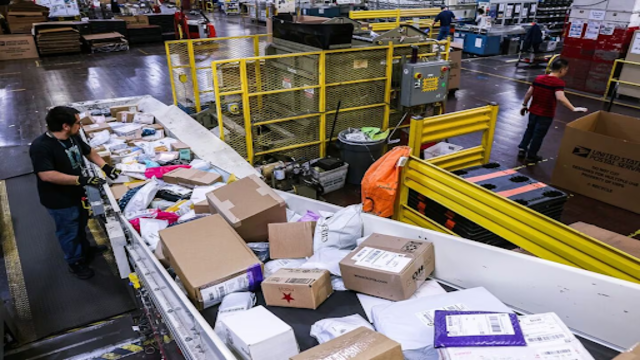
A worker sorts packages at the United States Postal Service Dulles Processing and Distribution Center in Dulles, Virginia. Ctvnews
Canadian small businesses are scrambling after U.S. President Donald Trump ended the long-standing de minimis exemption. The rule had allowed packages under US$800 to enter the United States duty-free, making cross-border sales easy and affordable.
With the exemption gone, Canadian businesses fear losing access to their American customers, who now face steep tariffs.
Tariffs Hit Small Packages
Canada Post confirmed that most Canadian parcels will now face a 35 percent duty at the U.S. border. Only packages worth less than US$100, sent by individuals and not businesses, will remain exempt.
For Canadian entrepreneurs who rely heavily on U.S. buyers, the change is devastating.
Businesses Halt U.S. Shipping
Elana White, owner of Outer Layer, a Toronto-based gift shop, said she has already stopped shipping to the United States.
“I suspended shipping earlier this week,” White explained. “It’s confusing right now. No one really knows how much it’s going to cost. To avoid conflict with customers, I had to pause.”
In British Columbia, Marion Kao of Korriko Pet Supply voiced similar concerns. Her company relied on the U.S. for 60 percent of its revenue.
“We had to shut off shipping to the U.S.,” she said. “This could be the end. Hopefully it’s not.”
Rising Costs for Consumers
Some businesses will try to continue shipping but expect American buyers to shoulder the extra costs.
Cal Green, who runs Ottawa-based streetwear brand Raised By Wolves, said U.S. sales will no longer be central to his business.
“Long-time customers will be surprised,” Green admitted. “I’ll have to pass the costs on. Instead, I’m leaning into Canadian production and collaborations.”
Antiques and Speciality Sellers Struggle
For niche sellers, the change is equally alarming.
Dave Pelkey, who operates The Vintage Crate, said his antique sales depend heavily on American platforms like eBay and Etsy.
“Sixty percent of my antique business comes from U.S. buyers,” he said. “Now, with tariffs and brokerage fees, we may have to shut down those stores.”
Pelkey initially hoped trade protections under the Canada-U.S.-Mexico Agreement (CUSMA) would apply. But he learned that Trump classified the exemption’s removal as a national security issue, preventing CUSMA coverage.
“Somehow shipping an antique toy is a national security issue,” he said.
Why the Rule Was Ended
The de minimis exemption was originally designed to ease pressure on U.S. border agents, who struggled with paperwork for low-value packages. But Trump linked the exemption to drug smuggling.
The White House claimed that Chinese exporters were exploiting small packages to hide synthetic opioids like fentanyl. In July, the administration issued an order collapsing the exemption for all countries, including Canada.
A Global Response
The United Nations reported that at least 25 countries have suspended mail service to the United States. This list includes U.S. allies like Australia, South Korea, and New Zealand, as well as major trade partners such as China, India, and Mexico.
Canada Post announced it would partner with Zonos to process duties and transfer payments to U.S. Customs. “We’ve worked to secure solutions to maintain business continuity,” the service said.
Still, Canadian entrepreneurs fear the damage may already be irreversible.
“This is historic,” Pelkey said. “Post offices worldwide have stopped shipping to the U.S. The impact is enormous.”