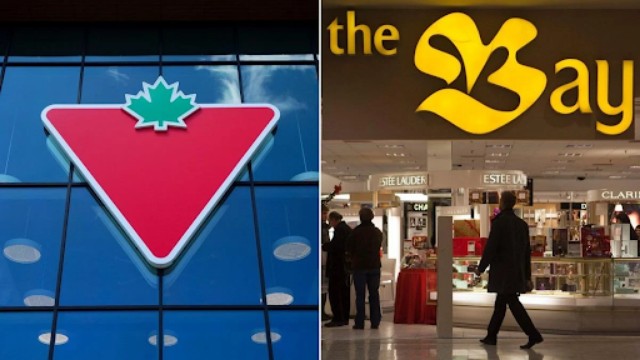
A combined photo displays the storefront signs of Canadian Tire on the left and Hudson’s Bay on the right. (Photo credit: THE CANADIAN PRESS/Sean Kilpatrick, Pawel Dwulit)
Canadian Tire is now the proud new owner of Hudson's Bay's most iconic trademarks, following a judge’s approval on Tuesday. The Ontario court decision clears the path for a $30-million deal that marks a turning point for the 355-year-old company, which recently went into liquidation and closed all of its stores.
Judge Peter Osborne, who approved the sale, described it as “the best outcome” given Hudson’s Bay’s financial collapse. The purchase gives Canadian Tire control over the legendary Bay name, its recognizable coat of arms, signature stripes, and several other well-known trademarks.
Also included in the package are the "Bay Days" slogan, the Hudson North apparel label, the Distinctly Home brand, and even the old Zellers catchphrase, “lowest price is the law.” A licensing deal with the U.S.-based Pendleton Woolen Mills also forms part of the agreement.
Hudson’s Bay, once Canada’s oldest company, officially ended operations last weekend by closing all 96 of its Bay and Saks stores. Judge Osborne called the closures “the end of an era,” reflecting the company’s struggles to attract a new investor willing to salvage its traditional business model.
Canadian Tire emerged as the winning bidder after Hudson’s Bay and its advisors reached out to over 400 companies and individuals. Seventeen bids came in, and while thirteen were for trademarks and intellectual property, Canadian Tire offered the strongest proposal.
Hudson’s Bay lawyer Ashley Taylor noted that Canadian Tire’s bid was the “highest and best offer” and came from a competitive process. However, details of what made the offer stand out remain under seal, as the court agreed to keep certain information confidential due to its commercial sensitivity.
Among the trademarks Canadian Tire now owns are references to the “Hudson’s Bay Royal Charter” and the “Royal Charter,” nods to the company’s 1670 founding document. However, these phrases are limited in use—one may only be used for whisky, while the other can apply to whisky, brandy, or coffee.
This trademark sale is just the beginning. More deals related to Hudson’s Bay’s former assets are on the horizon. One upcoming deal involves Ruby Liu, a B.C. mall owner interested in taking over up to 28 Bay store leases for a new retail concept. Additional asset transactions are expected soon.
The court hearing also addressed a real estate partnership between Hudson’s Bay and RioCan. RioCan requested a receivership for their 12 joint property leases to protect stakeholder interests. Judge Osborne approved the motion and appointed FTI Consulting Canada to manage the process and oversee asset liquidation.
In a separate but significant ruling, Osborne acknowledged Hudson’s Bay’s former staff—over 9,000 of them—as eligible for financial recovery through the federal Wage Earner Protection Program. This allows affected employees to claim up to $8,844.22 for unpaid wages and vacation time.