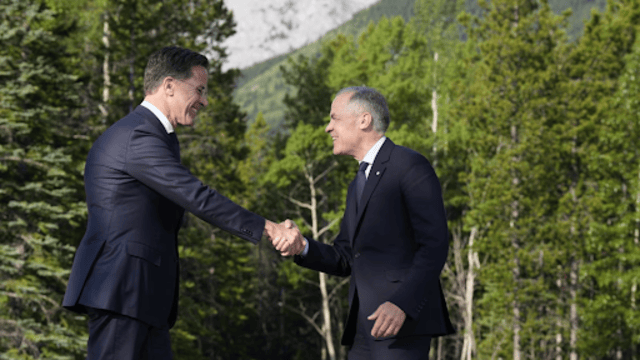
Prime Minister Mark Carney shakes hands with NATO Secretary General Mark Rutte during the G7 Summit held in Kananaskis, Alberta, on Tuesday, June 17, 2025. The Canadian Press
Prime Minister Mark Carney landed in Europe on Sunday to attend key defence and security meetings. He is set to take part in back-to-back summits focused on military cooperation. Carney is joined by Foreign Minister Anita Anand, Defence Minister David McGuinty, and Defence Procurement Secretary Stephen Fuhr.
Visit Starts in Belgium
Carney began his visit in Brussels, Belgium. He first visited the Antwerp Schoonselhof Military Cemetery, where 348 Canadian soldiers are buried. He also plans to meet with top European leaders, including Belgian Prime Minister Bart De Wever and European Commission President Ursula von der Leyen.
EU-Canada Security Deal
At the EU-Canada summit, Canada and the EU are expected to sign a major defence agreement. Officials say it’s one of Europe’s most ambitious deals with a non-EU country. The agreement will let Canada join the ReArm Europe plan, which gives access to a €150-billion loan program for defence purchases.
A Canadian official said this first agreement will allow Canada to join some joint defence projects. A second agreement will be needed to let Canadian businesses bid on defence contracts.
Leaders are also expected to release a joint statement calling for more sanctions on Russia and a ceasefire in Gaza.
Talks Continue in Netherlands
After Brussels, Carney will go to The Hague for the NATO summit. He will meet with the King of the Netherlands and leaders from Nordic countries to discuss Arctic and Atlantic security.
Carney will also hold one-on-one talks with other world leaders. The summit includes a formal dinner and a session of the North Atlantic Council.
Rising Defence Spending
At NATO, one of the big topics is a new spending goal. Allies are debating whether to raise the defence target to 5% of each country's GDP. Currently, no NATO country meets that target. Canada spent 1.37% of its GDP on defence in 2024, up from 1.01% in 2014.
Canada hasn’t reached the 2% NATO goal since the 1980s. Some countries want to hit the 5% goal in seven years, while others suggest ten years. Any change needs all 32 NATO countries to agree.
Concerns About U.S. Commitment
Former Canadian NATO ambassador Kerry Buck says the packed summit schedule might be a way to avoid public disagreements, especially with the U.S. Buck called Donald Trump an “uncertainty engine” and warned that allies near Russia face real threats.
Trump has suggested the U.S. might stop backing NATO if members don’t boost spending. Buck said it’s important for Canada to help keep NATO strong, as it protects Canada too.