The Canadian Food Inspection Agency (CFIA) has found 12 instances of grocery stores using Canadian-style branding to market food that actually came from other countries. This practice, often called “maple washing,” misleads shoppers into thinking they are buying Canadian products when they are not. The cases were flagged after concerns were raised by consumers, including Sheila Young, who shared the information with authorities. CBC
The Canadian Food Inspection Agency (CFIA) has confirmed 12 cases of misleading Canadian branding on imported food products. Known as “maple washing,” this practice uses symbols such as the maple leaf to suggest that foreign goods come from Canada. These cases were reported between February and May, mostly involving large grocery chains.
The CFIA can fine up to $15,000 per violation. Despite this, no penalties were issued. The agency said it acted in each case and confirmed stores corrected the errors.
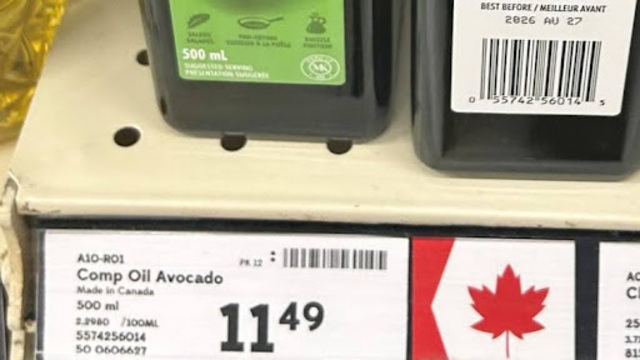
One case took four months to resolve. It involved avocado oil at a Sobeys-owned store near Edmonton that carried a maple leaf and “Made in Canada” label, though the bottle stated it was imported.
Shoppers Raise Concerns
Some shoppers worry that without penalties, misleading practices will continue.
“As consumers, we’re trying to do our part,” said Hamilton resident Brenda Nicholls. “I think the CFIA needs to step up and start levying fines, putting on some pressure, so that there will be some changes at the grocery store.”
Nicholls says she often finds misleading signs herself. At a Loblaw-owned Fortinos, she spotted blackberries promoted as Canadian while the package listed the U.S. as the origin. Later, she found asparagus promoted as Canadian, though the tag said it was from Peru.
Experts Call for Stronger Action
Marketing professor Tim Dewhirst believes regulators must do more. “At a certain point, you say, ‘Enough is enough.’ If there aren’t any fines despite repeated violations, it becomes that the regulations have no teeth,” he said.
Both Loblaw and Sobeys say they aim for accuracy but note challenges with large inventories and changing suppliers.
Federal rules require food labels and in-store signs to be truthful and accurate. “Made in Canada” and “Product of Canada” labels follow specific content rules. The maple leaf symbol cannot mislead shoppers.
Complaints Continue Nationwide
The CFIA has received 160 complaints about country-of-origin labels this year, with 40 confirmed violations. None of the cases resulted in fines. Most involved major grocers.
Sheila Young of Edmonton reported the misleading avocado oil in April. She felt disappointed it took four months to resolve. “It should be something that can be cleared up within a few weeks,” she said.
Sobeys later removed the maple branding from the avocado oil and other imported products.
Shoppers Urged to Stay Alert
Experts advise shoppers to check labels carefully. Dewhirst says, “Just because you see a maple leaf doesn’t mean it’s Canadian.”
Nicholls says she now shops mainly at independent stores selling local products. “It’s up to the consumer to speak with their wallet,” she said.