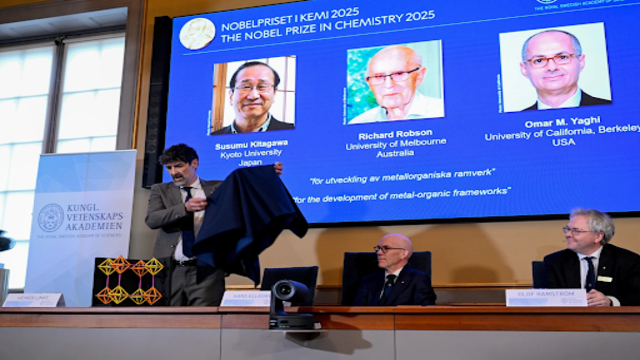
Chair of the Nobel Committee for Chemistry Heiner Linke makes a demonstration, next to Secretary General of the Swedish Academy of Sciences Hans Ellegren, and Member of the Nobel Committee for Chemistry Olof Ramstrom, right, after they announce Susumu Kitagawa, Richard Robson and Omar Yaghi, on screen behind, as the recipients the Nobel Prize in Chemistry, at the Nobel Assembly of the Karolinska Institutet, in Stockholm, Sweden, Wednesday, Oct. 8, 2025. Associated Press.
Three pioneering chemists have won the 2025 Nobel Prize in Chemistry for developing molecular structures that could transform the fight against climate change and water scarcity. Their groundbreaking discovery—metal-organic frameworks (MOFs)—has the potential to trap greenhouse gases and extract moisture from the driest air.
The Magic Inside Metal-Organic Frameworks
This year’s Nobel laureates—Susumu Kitagawa, Richard Robson, and Omar M. Yaghi—created MOFs, intricate lattice-like structures that can hold astonishing amounts of gas or liquid.
The Nobel Committee compared these frameworks to the magical handbags of Hermione Granger and Mary Poppins—small on the outside, yet able to hold vast quantities within. MOFs are made from metal nodes linked by organic rods, forming countless microscopic cavities capable of storing gases such as carbon dioxide, methane, or even water vapor.
A Global Solution in a Tiny Structure
The Nobel Committee praised the trio for discoveries that “may help solve humanity’s greatest challenges.” MOFs’ customizable pores allow precise control over which molecules are captured and released—an innovation that’s rare in chemistry.
A few grams of MOFs can have the internal surface area of a soccer field, said Imperial College London chemist Kim Jelfs. This enormous area enables efficient gas storage and filtering.
According to Dorothy Phillips, president of the American Chemical Society, the discovery could have life-changing implications. “If you can store toxic gases, it can help address global challenges,” she said.
Decades of Collaborative Innovation
Their achievement didn’t happen overnight. Robson began exploring similar frameworks in the 1980s. Over the decades, Kitagawa and Yaghi built upon his early work, refining the chemistry to create stable and tunable frameworks.
Though they worked independently, their findings complemented each other, collectively shaping one of modern chemistry’s most versatile materials.
Turning Science Into Real-World Impact
Researchers are now exploring several applications of MOFs. One major goal is carbon capture—removing greenhouse gases from the atmosphere or industrial sites. Another is water harvesting, where these structures could pull moisture from desert air to produce clean drinking water.
MOFs are also being studied for targeted drug delivery. Loaded with medicine, they could release doses slowly inside the body, improving treatments for diseases like cancer. “It could be a better way to deliver low doses continually,” said David Pugh, a chemist at King’s College London.
However, Pugh cautioned that “translating lab results into real-world applications remains a challenge,” as many MOFs perform best under high pressure or low temperatures.
From Fruit Shipping to Future Climate Solutions
MOFs are already finding unexpected uses. Some are integrated into packaging materials to keep fruit fresh during long transport, slowly releasing chemicals that delay ripening.
These early uses hint at the material’s broad potential—from preserving produce to cleaning the air.
The Winners React
Yaghi learned of his win mid-journey from San Francisco to Brussels. “You cannot prepare for a moment like that,” he said, calling the feeling “absolutely thrilling.”
In Japan, Kitagawa first thought the call was a telemarketing prank. “When an expert congratulated me, I finally thought it was real,” he said at Kyoto University.
Robson, 88, expressed both joy and disbelief. “This is a major thing that happens late in life,” he told the Associated Press. “But here we are.”
Continuing the Legacy of Scientific Excellence
The Nobel chemistry award follows other major 2025 prizes, including those in medicine, physics, and upcoming categories like literature, peace, and economics.
This year’s chemistry recognition honors not just three individuals, but a vision of science that could redefine how humanity tackles pollution and drought.
Their work stands as a testament to innovation—capturing CO2, harvesting water from air, and offering new hope for a sustainable planet.