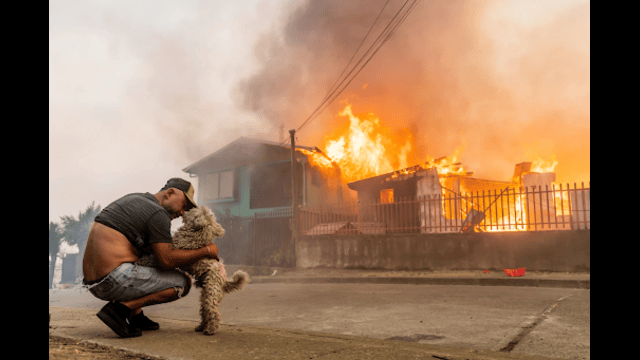
A member of the Gonzalez family pets his dog after the family’s home caught fire during wildfires in Lirquen, Chile, Sunday, Jan. 18, 2026.
Wildfires tore through central and southern Chile on Sunday, killing at least 18 people and displacing tens of thousands.
The fast-moving blazes destroyed homes, forests, and critical infrastructure as extreme heat gripped the country.
Authorities warned the death toll and damage figures were likely to rise in coming days.
Wildfires Trigger State of Catastrophe
President Gabriel Boric declared a state of catastrophe in the Biobío and Ñuble regions.
Both regions lie nearly 500 kilometers south of the capital, Santiago.
The emergency order allows greater coordination between civilian agencies and the military.
Officials said more than two dozen wildfires were burning out of control.
According to the national forestry agency, wildfires have already scorched 8,500 hectares of land.
Hundreds of homes were reduced to ashes within hours.
Rising Death Toll and Widespread Damage
Speaking from Concepción, President Boric expressed condolences to grieving families.
He warned that confirmed deaths and housing losses would likely increase.
Initial reports listed 300 destroyed houses.
Boric said affected homes in Biobío alone were already “certainly more than a thousand.”
The wildfires forced nearly 50,000 residents to evacuate.
Entire neighborhoods emptied as flames raced down hillsides.
Local Leaders Voice Anger and Frustration
Several local officials criticized the delayed emergency response.
Rodrigo Vera, mayor of the coastal town of Penco, voiced his anger publicly.
He said communities burned for hours without visible government support.
Vera questioned why military assistance arrived so late.
His comments echoed growing frustration across affected towns.
Extreme Heat and Winds Fuel Wildfires
Firefighters battled relentless flames under brutal conditions.
Temperatures climbed above 38 degrees Celsius on Sunday.
Strong winds repeatedly shifted fire lines, complicating containment efforts.
Interior Minister Álvaro Elizalde warned conditions would worsen.
He said extreme temperatures were expected to continue into Monday.
Residents Caught Off Guard Overnight
Many residents said the wildfires erupted suddenly after midnight.
Some believed flames would stop at forest edges.
Instead, the fires leapt into residential areas.
John Guzmán, a Penco resident, described scenes of chaos and disbelief.
He said the wildfires quickly became uncontrollable.
Thick smoke turned the sky an eerie orange.
Towns Engulfed, Families Flee in Darkness
Large sections of Penco were consumed by fire.
Cars, a school, and a church were destroyed.
Thousands fled toward improvised emergency shelters.
Juan Lagos escaped with his children in total darkness.
He said families ran for their lives as embers fell around them.
Authorities imposed a nighttime curfew to maintain order.
Charred bodies were found in homes, vehicles, fields, and along roads.
A Familiar Summer Threat in Chile
Wildfires strike central and southern Chile almost every summer.
They usually peak in February as temperatures rise.
The country remains locked in a yearslong drought.
In 2024, massive wildfires killed at least 130 people.
That disaster became Chile’s deadliest since the 2010 earthquake.
Regional Impact Spreads Beyond Chile
Wildfires are also burning across neighboring Argentina.
Thousands of acres have been lost in southern Patagonia.
The region is facing unusually hot and dry conditions.
Authorities across South America remain on high alert.
As heat waves intensify, wildfires are becoming more frequent and deadly.