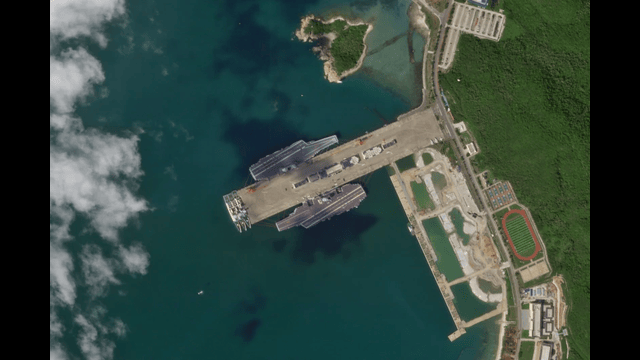
In this Oct. 8, 2025, satellite photo from Planet Labs PBC, the Chinese aircraft carriers Shandong and Fujian are seen at the Yulin Naval Base near Sanya, China
China has officially commissioned its third and most advanced aircraft carrier — the Fujian — marking a major milestone in its quest to expand military power beyond its shores. The commissioning ceremony took place on Hainan Island, attended by President Xi Jinping, symbolizing Beijing’s growing ambition to build a “world-class” military force by mid-century.
A Homegrown Symbol of Power
The Fujian stands apart from its predecessors, Liaoning and Shandong. Unlike the earlier models—one Soviet-built and the other Soviet-inspired—the Fujian is entirely designed and constructed in China. This makes it the most significant achievement in China’s naval modernization drive.
Experts say the Fujian marks China’s transition from a regional maritime power to a global one. With its cutting-edge technology, it represents Xi Jinping’s broader vision of transforming the People’s Liberation Army Navy (PLAN) into a blue-water force capable of operating far beyond the country’s coastal waters.
“Carriers are key to China’s vision of becoming a great power with a blue-water navy,” explained Greg Poling, Director of the Asia Maritime Transparency Initiative at the Center for Strategic and International Studies (CSIS).
Expanding Reach Beyond Asia
The Fujian isn’t just about coastal defense — it’s a strategic move toward projecting power across the Indo-Pacific and beyond. China’s navy already dominates the First Island Chain — the waters stretching through Japan, Taiwan, and the Philippines. Now, its sights are set on the Second Island Chain, which includes Guam, a key U.S. military hub.
As Poling notes, “A carrier doesn’t help much within the First Island Chain, but it’s critical for competing with the U.S. in the wider Pacific.”
This expansion fits with Beijing’s long-term goal: ensuring it can challenge U.S. influence in key strategic waters and safeguard its growing overseas interests.
Fujian’s Advanced Launch Technology
The Fujian is the first Chinese carrier equipped with an electromagnetic aircraft launch system (EMALS), a technology used only on the U.S. Navy’s latest Ford-class carriers. EMALS allows aircraft to take off with heavier payloads, increasing operational efficiency and extending flight range.
This advanced system replaces the older ski-jump ramps used on China’s previous carriers. It enables the Fujian to launch state-of-the-art aircraft like the stealthy J-35 fighter, the J-15T heavy fighter, and the KJ-600 early warning aircraft — giving it “full-deck operation capability.”
With these upgrades, China can now operate further from its coastline and sustain operations without depending on land-based support.
Regional Reactions and Global Implications
Japan reacted cautiously to the Fujian’s commissioning. Former Defense Minister Minoru Kihara warned that China was “rapidly strengthening its military power without transparency.” He emphasized Japan’s commitment to monitor Chinese activity and respond “calmly but decisively” if needed.
The Fujian’s debut also heightens tensions over Taiwan. Analysts suggest that if China positions carrier groups beyond the Second Island Chain, it could delay U.S. intervention in a Taiwan conflict.
Brian Hart, Deputy Director of CSIS’s China Power Project, noted that China’s carriers are key to extending its “strategic perimeter” and expanding its surveillance reach across the sea, air, and underwater domains.
Closing the Gap with the U.S. Navy
Despite its progress, China still trails the U.S. Navy in key areas. The U.S. operates 11 nuclear-powered carriers, while China’s three are conventionally powered — limiting their range and endurance.
The U.S. also maintains a vast global network of naval bases, essential for resupply and emergency operations. China, meanwhile, is only beginning to expand its overseas military presence, with bases in development in Africa and Asia.
Still, China’s rapid shipbuilding pace is unmatched. Shipyards are already working on new carriers, including a potential nuclear-powered model. “Across the board, China’s closing the gap,” Hart observed.
Showcasing Military Might
China has showcased the Fujian and its aircraft fleet in military parades and promotional footage. A recent parade also displayed hypersonic missiles, drones, and advanced electronic warfare systems — underscoring its ambitions to deter global powers and project strength.
However, experts caution that display does not equal readiness. “It’s possible China’s capabilities are overstated,” said Tang Meng Kit, an analyst at Singapore’s S. Rajaratnam School of International Studies. He argued that despite its technological advances, China’s military still lacks real combat experience.
A Message Beyond the Seas
The Fujian represents more than a naval upgrade — it’s a statement of intent. China aims to secure global influence, safeguard overseas interests, and reinforce its status as a world power.
While questions remain about readiness and endurance, the Fujian sends a clear message: China’s navy is no longer confined to its coastline. It is preparing to sail — and compete — on the world’s oceans.