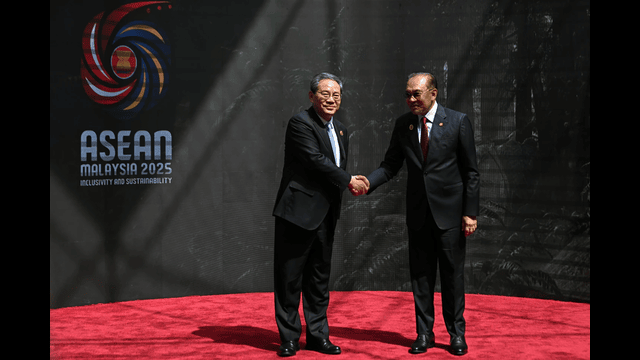
China’s Premier Li Quing , left, shakes hands with Malaysia's Prime minister Anwar Ibrahim as he arrives at the Kuala Lumpur convention centre to attend the 47 th ASEAN summit.
China has signed an upgraded free trade agreement with the Association of Southeast Asian Nations (ASEAN), marking a major step in its effort to position itself as a global trade partner against the backdrop of U.S. protectionist policies.
Chinese Premier Li Qiang highlighted the agreement as an opportunity to promote unity and shared growth in the region. His remarks came during the ASEAN-China Summit, where he called for stronger cooperation amid rising global economic uncertainty.
Li Qiang Urges Solidarity Over Confrontation
Addressing ASEAN leaders after the signing, Li said cooperation—not confrontation—was the key to overcoming global economic challenges.
“Pursuing confrontation instead of solidarity brings no benefit,” he said, in a clear reference to U.S. trade policies under President Donald Trump.
He added, “Unity is strength,” quoting President Xi Jinping’s earlier message during a Southeast Asia visit. Li emphasized that mutual reliance among China and ASEAN nations—spanning Brunei, Cambodia, East Timor, Indonesia, Laos, Malaysia, Myanmar, the Philippines, Singapore, Thailand, and Vietnam—was crucial for regional stability.
ASEAN-China Free Trade Area 3.0: A New Chapter
The signing of the ASEAN-China Free Trade Area 3.0 took place on the final day of the annual ASEAN summit. The agreement was witnessed by Li Qiang and Malaysian Prime Minister Anwar Ibrahim, who currently chairs ASEAN.
This marks the third revision of the long-standing agreement first signed in 2002 and implemented in 2010. The pact now covers a combined market of over 2 billion people, aiming to expand trade, boost investment, and ease market access across the region.
The upgraded agreement introduces new elements such as digital trade, green economy cooperation, and support for small and medium-sized enterprises (SMEs)—which form the backbone of ASEAN economies. It also aims to simplify non-tariff procedures and remove regulatory barriers to ensure smoother cross-border commerce.
Pushback Against U.S. Protectionism
Li criticized the rise of unilateralism and protectionism, saying such policies have disrupted global trade order.
“External forces are increasing their interference in the region. Many countries face unreasonably high tariffs,” he said.
He urged ASEAN nations to stand together to defend their “legitimate rights and interests,” presenting China as a more reliable trade partner than the U.S.
Meanwhile, the United States continues to impose new tariffs on several ASEAN countries, even as Trump’s administration seeks fresh trade arrangements with Cambodia, Malaysia, Thailand, and Vietnam.
Analysts See Strategic Benefits
Southeast Asian political analyst Bridget Welsh said the upgraded trade pact reflects a global shift.
“It highlights how non-U.S. countries are strengthening their trade relationships to secure growth as the world rebalances,” she noted.
She added that the agreement would particularly enhance supply chain resilience and promote sustainability—two areas critical to ASEAN’s long-term development.
ASEAN Balances Relations with Major Powers
Prime Minister Anwar Ibrahim reiterated ASEAN’s balanced approach to diplomacy.
“The day before we were with President Donald Trump of the United States, and today we are back with China,” he said.
“This reflects ASEAN centrality—steady engagement that fosters trust and enables us to tackle challenges together.”
This balanced stance underscores ASEAN’s aim to remain neutral yet cooperative amid global tensions between Washington and Beijing.
Looking Ahead: Toward Regional Integration
Officials said the Free Trade Area 3.0 would deepen regional integration by addressing modern trade priorities. Its provisions are designed to make trade benefits more inclusive and accessible, especially for smaller businesses.
Malaysia’s Trade Minister Zafrul Aziz said ASEAN-China cooperation remains vital:
“China has been ASEAN’s largest trading partner for years. But ASEAN is now equally important to China, making it a truly two-way relationship.”
With both sides committed to innovation, sustainability, and open trade, the ASEAN-China Free Trade Area 3.0 marks a decisive step toward a more interconnected and resilient regional economy—one that stands as a clear alternative to the U.S.-led protectionist model.