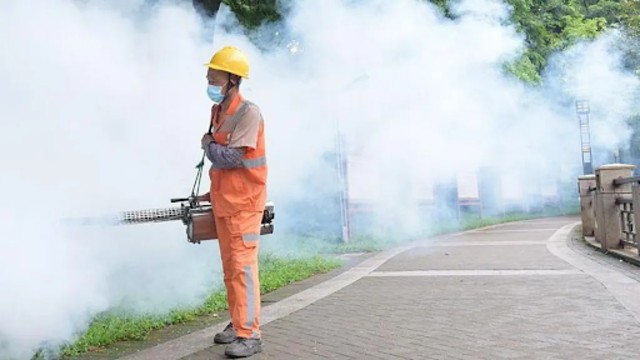
Guangdong authorities have vowed to take "decisive and forceful measures" to stop the spread of the disease
A fast-spreading outbreak of the chikungunya virus in China’s Guangdong province has sparked intense public health measures, echoing some strategies seen during the COVID-19 pandemic. With over 7,000 reported infections and growing concern among residents, authorities are deploying everything from fines and drones to mosquito-eating fish in a sweeping effort to control the spread.
The epicentre of the outbreak is Foshan, a manufacturing city near Hong Kong, where thousands have fallen ill since July. Local officials report that while new cases are slightly declining, nearly 3,000 infections were logged just last week alone.
China Responds with Aggressive Control Tactics
In Foshan, authorities have enforced hospital stays for infected patients. Those hospitalized are required to stay for a full week or until they test negative. During their stay, patients are kept under mosquito nets to prevent further transmission.
While the virus is not contagious between humans, it spreads when a mosquito bites an infected person and later bites someone else. Chikungunya is transmitted through infected mosquitoes and can cause fever, rash, and severe joint pain, which in some cases lasts for months or even years.
Despite all current cases in China being classified as mild, health officials aren’t taking any chances.
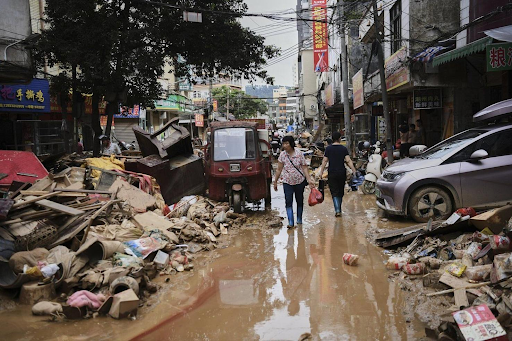
Locals navigate debris-strewn streets in Huaiji County, Guangdong, after floodwaters, a factor linked to mosquito breeding, intensified concerns amid the Chikungunya outbreak (Xinhua via AP)
Residents Face Fines Over Stagnant Water
Local governments across Guangdong are taking an aggressive stance against mosquito breeding grounds. Households are being instructed to eliminate standing water—even in unlikely spots like flowerpots or coffee machine trays. Failure to comply could result in fines up to 10,000 yuan ($1,400).
Officials have also released thousands of “elephant mosquitoes”, a species known to eat smaller, disease-carrying mosquitoes, and larvae-eating fish into public water bodies. Last week alone, 5,000 such fish were released into lakes in Foshan. In addition, drones are scanning rooftops and alleys for hidden pools of water where mosquitoes could breed.
Some of these measures have sparked public debate. On social media platform Weibo, users are questioning whether this level of enforcement is necessary, especially since the virus doesn’t spread person to person. Comments range from concerns over quarantine rules to fears of long-term effects.
Panic and Precaution
The outbreak has stirred anxiety among residents, especially due to the lack of familiarity with chikungunya in China. One social media user wrote, “This is scary. The long-term pain sounds unbearable.”
Adding to the concern, Hong Kong recently reported its first case—a 12-year-old boy who had traveled to Foshan and returned with symptoms. This prompted the U.S. to issue a travel advisory, asking Americans to exercise increased caution when visiting China.
While some nearby cities had briefly enforced 14-day home quarantines for visitors from Foshan, those rules have now been lifted.
Tracing Back Chikungunya. Should You Be Worried?
Chikungunya was first identified in Tanzania in 1952 and has since spread to over 110 countries. Though uncommon in China, it’s regularly seen in South and Southeast Asia and parts of Africa.
Symptoms usually appear 3 to 7 days after a mosquito bite. Besides fever and joint pain, patients may experience headaches, muscle aches, rash, and swollen joints. Most recover within a week, but in some cases, joint pain can persist for months or even years.
While deaths from the virus are rare, elderly individuals, newborns, and people with chronic conditions are at greater risk of complications.
There is no specific treatment or vaccine, making prevention the only safeguard. The World Health Organization (WHO) stresses the importance of eliminating stagnant water to disrupt the mosquito breeding cycle.
Familiar Fears, New Virus
Many Chinese citizens are drawing comparisons to the early COVID-19 response, particularly as some cities consider sweeping public health rules. However, experts and officials are quick to note that chikungunya is not a pandemic-level threat, and the virus’s spread is controllable through local containment.
For now, China’s efforts to curb the spread appear to be yielding early results. However, with thousands still vulnerable and the public on edge, the coming weeks will be critical in determining whether this outbreak can be fully contained—or if it becomes another long battle.