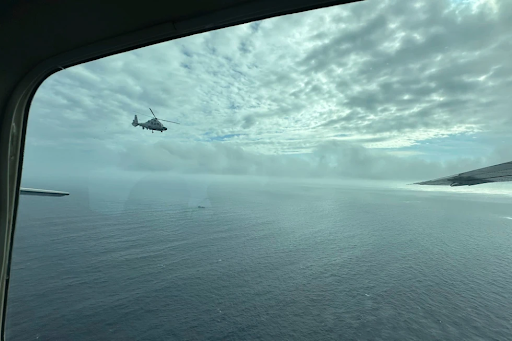
A Chinese military helicopter flies close to a Philippine Bureau of Fisheries and Aquatic (BFAR) aircraft above Scarborough shoal on Feb. 18, 2025. Associated Press
China’s latest declaration of a nature reserve in the South China Sea has stirred skepticism among global experts. Beijing claims the move aims to protect coral reefs around Scarborough Shoal. Analysts, however, argue that the decision is rooted more in geopolitics than in environmental care.
Scarborough Shoal, also known as Huangyan Island, is a contested triangular reef chain with a lagoon rich in marine life. The Philippines and Taiwan also claim sovereignty over this resource-filled territory.
China Tightens Grip on Scarborough Shoal
China has effectively controlled the shoal since a 2012 standoff with the Philippines. While Philippine vessels still attempt to approach the area, confrontations with Chinese ships have grown increasingly tense. In August, two Chinese vessels collided while intercepting a Philippine ship near the reef.
China has already marked the waters as its territory and even released baselines with geographic coordinates. Experts believe the nature reserve is another step in building administrative justifications for military control.
Coral Reefs Damaged by Giant Clam Harvesting
Environmental scholars highlight that Chinese fleets have inflicted massive harm on Scarborough Shoal’s coral ecosystem. For years, giant clam harvesting destroyed reefs, with propellers and later high-pressure water jets used to extract clams.
These shells gained popularity as substitutes for elephant ivory, fueling extensive trade. Although harvesting was banned in 2023, the ecological scars remain. Marine experts compare the damage to an “arsonist becoming the fire marshal,” accusing China of diverting attention from its own destructive practices.
Conservation or Political Strategy?
China’s state media framed the reserve as both an ecological project and a signal of “long-term maritime governance.” This narrative aligns with Beijing’s shift from reacting to rival claims to actively governing disputed areas in the South China Sea.
International scholars, however, describe it as the weaponization of environmental concerns. James Borton, a senior fellow at Johns Hopkins, stressed that while marine scientists work to restore reefs, policymakers are politicizing conservation.
Experts remain unconvinced about restoration efforts. Some argue that while small patches of coral may be replanted, the shoal overall resembles a “graveyard” where most marine life has already perished.
Will China Build Another Artificial Island?
China has faced sharp criticism for island-building in the South China Sea, particularly in the Spratly Islands. However, experts doubt Scarborough Shoal will see the same transformation.
“It would be strange to announce a nature reserve and then build a runway there,” said Ray Powell of Stanford’s SeaLight project.
The memory of Mischief Reef lingers. In 1995, China erected huts for “fisher safety” in the Spratlys. Over time, those shelters expanded into airstrips and military facilities, alarming neighboring nations.
Still, analysts say Scarborough Shoal’s location makes large-scale construction unnecessary. The reef lies closer to China’s mainland compared to the Spratlys. According to Greg Poling of CSIS, Beijing does not need another deep-water harbor or airstrip at the site.
A Battle of Claims Continues
The declaration of a coral reef reserve in the South China Sea highlights China’s dual agenda — ecological on the surface, strategic at its core. While Beijing presents itself as protector of fragile reefs, experts remain unconvinced.
For rival claimants like the Philippines and Taiwan, the reserve is seen as yet another tool in Beijing’s long-term bid to cement control over one of the world’s most contested waterways.