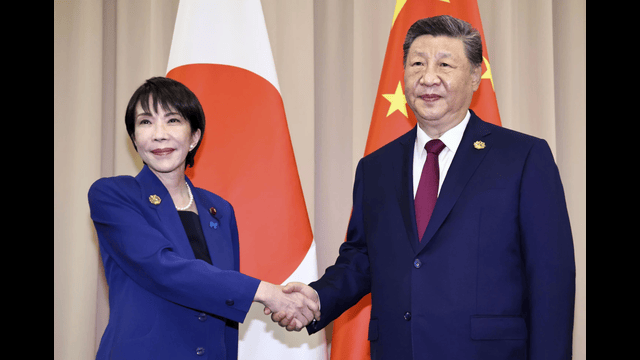
China President Xi Jing ping, right, shakes hands with Japanese prime minister Snae Takachi ahead of their meeting in Gyeongju, South korea, Oct 31, 2025.
Japan and China are facing fresh diplomatic friction after Japanese Prime Minister Sanae Takaichi suggested that a Chinese move against Taiwan could trigger a Japanese military response. Her statement, made less than a month into her term, has added new pressure to already delicate China-Japan relations.
A Bold Shift in Japan’s Taiwan Policy
Speaking before a parliamentary committee on November 7, Takaichi said that a Chinese naval blockade or similar action targeting Taiwan could justify the deployment of Japan’s Self-Defense Forces.
Her remarks marked a sharp departure from past Japanese leaders, who expressed concern over Beijing’s pressure on Taiwan but stopped short of outlining specific military responses.
Takaichi refused to retract the statement but later said she would avoid discussing operational scenarios in public. Known for her strong pro-Taiwan stance, the prime minister views China as a strategic threat and has ordered Japan to accelerate its military buildup.
Foreign Minister Toshimitsu Motegi, however, insisted that Japan’s basic position on Taiwan remains unchanged.
China Reacts With Strong Criticism
Beijing swiftly condemned Takaichi’s comments. Multiple Chinese bodies—including the Foreign Ministry, Defense Ministry, and Taiwan Affairs Office—issued statements warning Tokyo against interfering in what Beijing calls its internal affairs.
Wang Huiyao, president of the Center for China and Globalization in Beijing, said the remarks were unexpected, especially since cross-strait tensions were not particularly high at the moment.
A now-deleted post by China’s consul general in Osaka, who used offensive language to denounce Japan, further intensified the uproar. Motegi labeled the remarks “extremely inappropriate.”
China summoned Japan’s ambassador for a formal warning. The next day, Japan summoned China’s ambassador in Tokyo in protest over the inflammatory social media post.
Beijing Raises Diplomatic and Economic Pressure
China has begun taking steps that appear aimed at increasing pressure on Japan.
On Friday night, Beijing issued a travel advisory discouraging tourism to Japan. Chinese visitors are a crucial part of Japan’s tourism industry, with 7.5 million arrivals in the first nine months of the year—accounting for roughly one-fourth of all visitors.
China’s Education Ministry then issued a warning about alleged crimes targeting Chinese nationals in Japan, though it did not restrict travel.
On Sunday, China’s coast guard announced patrols near a disputed island chain claimed by both nations.
A more serious economic threat would be if Beijing curtailed exports of rare earth magnets, vital for Japan’s automotive and electronics sectors. So far, however, there is no sign China intends to do so.
Japan is attempting to lower tensions. Motegi said he will urge China to take steps that prevent long-term damage to bilateral ties.
U.S.-Japan Alliance Complicates the Picture
Japan’s constitutional restrictions on military force create additional complexity. The post-war constitution bans offensive military action, though a 2015 law expanded Japan’s ability to support allies under collective self-defense—primarily aimed at assisting the United States.
Takaichi, a protégé of former Prime Minister Shinzo Abe, indicated that a Chinese attack on Taiwan could meet the threshold of an “existential threat,” allowing Japan to aid the U.S. militarily.
Analysts say this interpretation could also apply if a U.S.-North Korea conflict erupted. However, Japan has never clearly defined what qualifies as such a threat.
Tokyo now finds itself in a delicate position. Walking back Takaichi’s Taiwan comments could weaken Japan’s strategic flexibility and damage her popularity, especially among voters who support a tougher stance on China.
A Pivotal Moment for China-Japan Relations
The Taiwan issue, already a historic flashpoint, has now become an immediate test for Japan’s new leadership. Takaichi’s remarks signal a more assertive era in Japanese security policy, while China’s response shows how quickly the Taiwan dispute can inflame regional tensions.
As Beijing applies diplomatic and economic pressure, Tokyo seeks to avoid a prolonged standoff—but also wants to maintain strategic clarity. For now, the China-Japan spat over Taiwan continues to reshape the geopolitical landscape in East Asia.