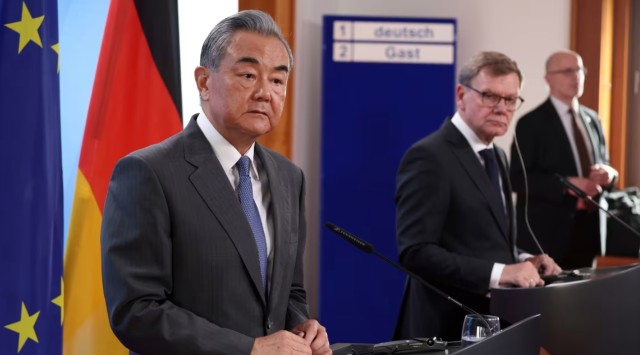
German Foreign Minister Johann Wadephul and Chinese Foreign Minister Wang Yi speak to the media following talks on July 3, in Berlin.
In a rare and candid moment during a four-hour meeting in Brussels, Chinese Foreign Minister Wang Yi reportedly told the European Union’s top diplomat that China cannot accept a Russian defeat in Ukraine. The closed-door meeting with EU foreign affairs chief Kaja Kallas reportedly covered a wide range of issues—ranging from Taiwan to cybersecurity and trade imbalances—but it was Wang’s stance on the Ukraine war that stood out.
According to an official briefed on the meeting, Wang suggested that a Ukrainian victory could allow the United States to shift its full strategic focus to countering China. These comments offer a stark contrast to China’s long-held public position of neutrality in the Russia-Ukraine conflict.
Behind Beijing’s Words: What China’s Ukraine War Stance Really Means
Publicly, China maintains that it is not a party to the Ukraine war.
At a press briefing on Friday, Chinese Foreign Ministry spokeswoman Mao Ning reiterated Beijing’s official line: “China’s position on the Ukraine crisis is objective and consistent—negotiation, ceasefire, and peace.”
She emphasized that China supports a swift political settlement and promised that Beijing would “continue playing a constructive role” along with the international community.
However, Wang Yi’s private remarks suggest otherwise.
If true, this revelation raises questions about whether China would prefer a prolonged war in Ukraine. Such a scenario could keep U.S. attention split and slow down the West’s pivot toward confronting China directly in the Indo-Pacific region.
China and Russia: A Strategic Bond That Goes Beyond Neutrality
Weeks before Russia’s full-scale invasion of Ukraine in 2022, Chinese President Xi Jinping and Russian President Vladimir Putin declared a “no limits” partnership.
Since then, the two countries have deepened economic and political ties. China has presented itself as a peace broker, but its growing closeness with Moscow reveals a far more complicated alignment.
For Beijing, Russia remains a critical geopolitical ally. Losing Moscow’s support—or watching it crumble under Western pressure—could isolate China in future global power struggles.
This fear likely plays into Beijing’s reluctance to see Russia lose.
The Accusations Mount: Is China Helping Russia Militarily?
Despite denying direct involvement, China faces growing scrutiny for allegedly aiding Russia’s military capabilities.
Ukraine has sanctioned several Chinese companies for supplying drone components and missile technology to Russia.
Just days ago, Ukraine’s Foreign Minister Andrii Sybiha shared images of drone debris from a Russian attack on Kyiv. One piece of the drone’s fuselage reportedly read: “Made in China – June 20.” Sybiha further noted that the Chinese Consulate in Odesa suffered minor damage in the same round of Russian strikes.
He called the incident a powerful metaphor, stating that “Putin continues to escalate his war and terror while involving others—North Korean troops, Iranian weapons, and some Chinese manufacturers.”
Allegations of Chinese Fighters in Ukraine
This year also saw reports that some Chinese nationals may be fighting alongside Russian forces in Ukraine. Beijing has firmly denied these claims, urging its citizens not to participate in any military activities abroad. Nonetheless, the allegations further complicate China’s claim of neutrality in the conflict.
A Delicate Balance Between War and Rivalry
While China continues to push for peace publicly, its behind-the-scenes maneuvers paint a different picture. Wang Yi’s alleged comments confirm what many international observers have suspected—China has far more at stake in Ukraine than it admits.
A prolonged war might serve China’s geopolitical interests by keeping the U.S. distracted. However, it also raises serious concerns about global security and China’s long-term role in shaping peace or perpetuating conflict.
As tensions mount and accusations pile up, the gap between China’s words and actions on the Ukraine war grows harder to ignore.