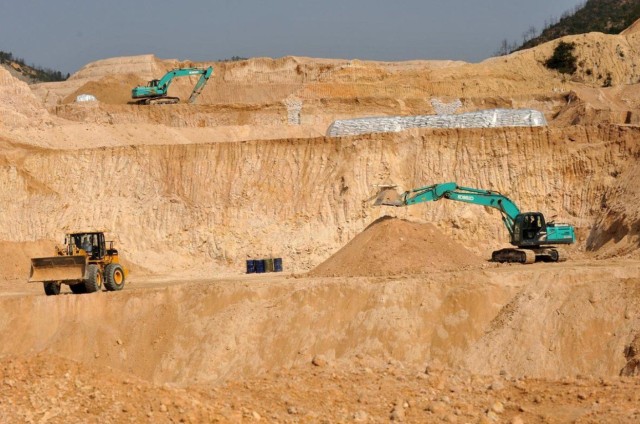
Workers use machinery to dig at a rare earth mine in Ganxian county in central China's Jiangxi province on Dec. 30, 2010. (Chinatopix via AP)
China has announced new controls on exports of rare earths and related technologies, signaling a tightening of access to these critical minerals. The move comes ahead of a planned meeting later this month between U.S. President Donald Trump and Chinese President Xi Jinping.
The Ministry of Commerce said foreign companies will now need special approval to export products containing even small amounts of rare earth elements sourced from China. In addition, Beijing will require permits for technologies linked to rare earth mining, smelting, recycling, and magnet-making.
China’s Dominance in Rare Earths
China dominates the global rare earth market, accounting for nearly 70% of mining and about 90% of processing. These elements are essential in a wide range of industries, including jet engines, radar systems, electric vehicles, laptops, and smartphones.
The minerals have long been a point of tension in trade talks between Washington and Beijing. With the U.S. imposing tariffs on many Chinese goods, China appears to be leveraging its rare earths exports as a strategic tool.
National Security Concerns
The Ministry of Commerce said the new rules aim to “better safeguard national security” and prevent rare earths or related technologies from being used in “sensitive fields such as the military.” Authorities noted that some overseas entities had transferred rare earth elements or technology abroad, causing “significant damage” to China’s national security.
These steps reflect Beijing’s growing focus on controlling not just the raw materials but also the technology associated with rare earths. Experts suggest that restricting technology exports could further complicate the global supply chain.
Timing Ahead of High-Stakes Talks
The announcement comes just weeks before a high-profile meeting between Trump and Xi, scheduled on the sidelines of the Asia-Pacific Economic Cooperation forum in South Korea. Analysts say rare earths will remain a key topic in negotiations.
“Both sides want more stability, but there will still be a lot of noise before a final deal can be reached,” said George Chen, a partner at The Asia Group. “These noises are part of negotiation tactics ahead of next year’s discussions.”
Previous Measures and Current Permits
China has previously implemented curbs on rare earth exports. In April, it restricted seven rare earth elements shortly after the U.S. imposed steep tariffs. However, in June, China approved some permits for rare earth exports and indicated it would speed up approval processes.
While details on enforcement overseas remain unclear, the latest rules signal Beijing’s determination to maintain tight control over these strategically vital resources. Manufacturers worldwide, particularly in the U.S., may face uncertainties regarding supply for both commercial and defense-related applications.
Implications for Global Industry
The new curbs highlight how rare earths are not just industrial commodities but also instruments of geopolitical influence. As global demand grows for technology, defense systems, and renewable energy, access to these materials will remain a sensitive and closely watched issue.
With the Trump-Xi meeting approaching, rare earths could be a pivotal bargaining chip, underscoring the complex interplay between trade, technology, and national security.