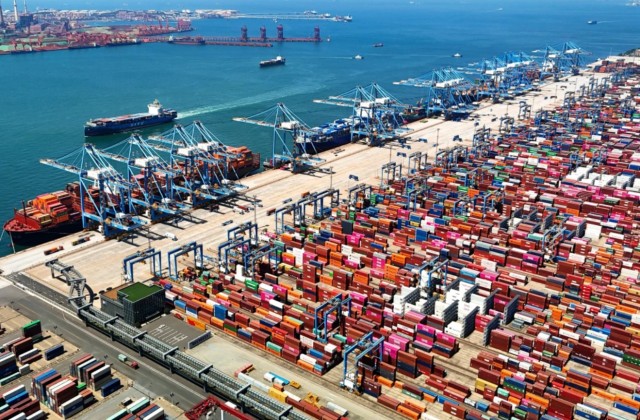
An aerial view of a container port is seen in Qingdao in east China’s Shandong province, on June 6, 2024.
China has made it clear that it will not back down in the face of President Donald Trump’s latest tariff threat. The Chinese Commerce Ministry stated on Sunday that Beijing prefers dialogue over confrontation but will “resolutely safeguard its legitimate rights and interests” if provoked.
This response came after Trump announced plans to impose a 100% tariff on Chinese imports by November 1. The move follows China’s new restrictions on rare earth exports — materials vital for military and consumer products.
“China’s stance is consistent. We do not want a tariff war, but we are not afraid of one,” the ministry said in its online statement.
Trump Softens Tone But Stands Firm on Demands
Hours after China’s statement, Trump took to Truth Social to address Chinese President Xi Jinping. He urged calm, saying, “Don’t worry about China, it will all be fine!” He added that the U.S. “wants to help China, not hurt it,” signaling a slightly softer approach without backing away from his trade stance.
Trump’s message appeared aimed at stabilizing U.S. financial markets, which saw a steep decline after his tariff announcement. The S&P 500 index dropped 2.7% on Friday — its worst day in six months — amid fears of renewed trade tensions between the two largest economies.
Vice President Vance Warns China Against ‘Aggressive’ Response
U.S. Vice President JD Vance defended Trump’s decision, calling China’s dominance over critical supplies a “national emergency.” He emphasized that the tariffs are meant to protect American industry and reduce dependence on Chinese materials.
“If China reacts aggressively, the president has far more cards to play,” Vance said during a Fox News interview. “But if Beijing chooses a reason, Trump will always be a reasonable negotiator.”
Vance’s remarks hinted at a cautious diplomatic balance, suggesting that the coming weeks will determine whether both sides escalate or ease tensions.
China Urges U.S. to Return to Dialogue
The Chinese Commerce Ministry warned that the “frequent resort to tariff threats” is not a constructive way to handle disputes. Instead, it called for “addressing concerns through dialogue” and urged Washington to “stop ignoring Chinese interests.”
Beijing also criticized the United States for recently expanding its export controls on Chinese companies. It accused Washington of violating the spirit of the trade truce reached earlier this year.
“If the U.S. obstinately insists on its practice,” the ministry said, “China will take firm countermeasures.”
Rare Earths at the Center of Trade Tensions
At the heart of the dispute lies China’s control over rare earth minerals — essential components in everything from electric vehicles and jet engines to smartphones. China produces about 70% of the world’s rare earths and controls nearly 90% of global processing.
Recently, Beijing imposed new rules requiring foreign companies to obtain government approval before exporting products containing Chinese-sourced rare earths. The measure, aimed at tightening control, has impacted manufacturers in the U.S., Europe, and other regions.
Trump, in turn, accused China of “becoming very hostile” and “holding the world captive” by limiting access to these critical materials.
Rising Trade Frictions Could Derail Upcoming Talks
The renewed tariff threats and export restrictions have cast doubt over a possible meeting between Trump and Xi. The two leaders were expected to discuss stabilizing trade relations, but escalating rhetoric from both sides threatens to reignite the trade war.
Adding to the strain, the U.S. has introduced new port fees on Chinese ships, set to take effect Tuesday. In retaliation, China announced similar fees on American vessels.
Outlook: A High-Stakes Standoff
As tensions rise, both nations seem determined to defend their economic interests. Trump insists on reducing U.S. dependency on China, while Beijing aims to assert its dominance in global supply chains.
Whether this latest dispute escalates into a full-blown U.S.-China trade war or returns to the negotiation table will depend on how both sides manage the next few weeks.
For now, one thing is clear — China is standing firm, and Trump isn’t backing down.