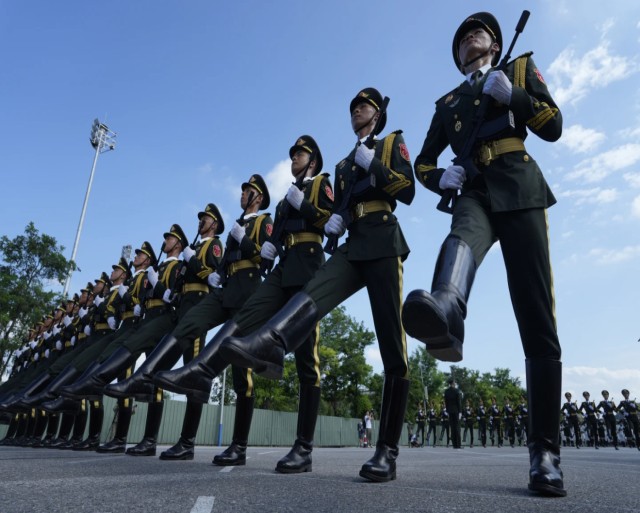
Chinese soldiers rehearsed at a camp of the Sept 3 military parade to commemorate the 90th anniversary of Japan’s World War 2 surrender, in Beijing on Aug 20, 2025.
China put its military might on display in a grand parade in Beijing on Wednesday. Missiles, fighter jets, drones, and other advanced weapons were showcased, many of them revealed to the public for the first time. President Xi Jinping led the event, highlighting both national pride and global attention.
Xi Jinping Leads the Ceremony
President Xi, who heads both the Communist Party and the military, reviewed the parade as troops marched in unison past Tiananmen Square. He also addressed the nation in a speech, commemorating the 80th anniversary of the end of World War II. Nearly two dozen foreign leaders were in attendance, seeking stronger ties with Beijing.
First Public Display of Advanced Weaponry
Chinese military officials confirmed that much of the hardware displayed had never been seen before. The lineup included strategic land, sea, and air weapons, along with state-of-the-art drones and precision warfare systems. Overhead, warplanes and helicopters flew in tightly coordinated formations, reinforcing the image of a highly modernized military force.
A Rare Parade Since 2019
This was China’s first major military parade since 2019, when the nation marked the 70th anniversary of the founding of communist China. This week’s event held deeper symbolism, reflecting on China’s suffering during World War II and its emergence as a global power. The spectacle aimed to inspire public confidence while signaling that China is ready to counter any threat.
Concerns Over Growing Military Strength
While the parade projected unity and confidence at home, it stirred unease abroad. China’s expanding military capabilities continue to worry the United States and neighboring Asian nations. For them, the display of power was not just ceremonial but also a reminder of Beijing’s growing influence in regional and global security.
Russia and North Korea Take the Spotlight
Notably absent were leaders from the U.S., Western Europe, Japan, India, and South Korea. However, North Korean leader Kim Jong Un attended, marking a rare foreign trip. Russian President Vladimir Putin and Iran’s president also joined the gathering, underscoring shifting global alliances. Several Southeast Asian leaders made the trip, though Indonesia’s president withdrew due to domestic unrest.
An Invitation-Only Event
Unlike public parades in many nations, this event was tightly choreographed and controlled. Ordinary citizens were not lining the streets. Security was strict, with guests and officials filling the audience instead. The celebration was designed more as a carefully staged performance for political leaders and international observers than a public festival.
A Strategic Show of Force
The military parade was more than just commemoration. It served as a strategic message: China is strong, unified, and ready to safeguard its sovereignty. By unveiling its latest military technology and gathering select global allies, Beijing aimed to reinforce its status as a rising power on the world stage.