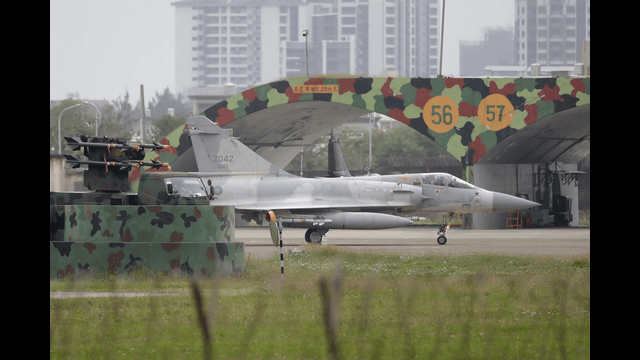
A Taiwan Mirage 2000 fighter jet runs past an airplane fort at an airbase in Hsinchu, northern Taiwan, Tuesday, Dec. 30, 2025.
China intensified pressure on Taiwan with a second day of major military drills on Tuesday.
The exercises featured live-fire operations and large-scale deployments around the island.
Beijing said the drills, named Justice Mission 2025, proved its ability to impose a blockade.
Chinese officials framed the move as a warning against foreign support for Taiwan.
Taiwan condemned the actions and warned of rising risks in the Taiwan Strait.
China Taiwan Military Drills Move Closer to the Island
Taiwanese defense officials said Chinese live rounds landed closer than in previous exercises.
Some rockets fell within Taiwan’s 24-nautical-mile zone, increasing alarm in Taipei.
Defense officials said the message was deliberate and highly symbolic.
They warned that China wanted to signal growing reach and confidence.
Airspace Disruptions Hit Civilian Life
The China Taiwan military drills affected more than military readiness.
Taiwan’s aviation authority reported seven temporary danger zones near the strait.
More than 150 flights faced delays, cancellations, or schedule changes in one afternoon.
Across the day, nearly 1,000 flights were disrupted due to safety restrictions.
Airlines and travelers felt the immediate impact of the standoff.
Massive Deployments Across Sea and Sky
China’s Eastern Theater Command led the operations.
Destroyers and frigates sailed north and south of Taiwan.
Fighter jets and bombers conducted coordinated air missions.
Ground units fired long-range live ammunition into nearby waters.
China said joint sea, air, and missile coordination achieved “desired effects.”
Taiwan Tracks Aircraft, Ships, and a Balloon
Taiwan’s Defense Ministry reported intense activity during the drills.
It detected 130 Chinese aircraft within 24 hours on Monday.
Fourteen warships and eight official vessels also appeared nearby.
Ninety aircraft crossed the median line of the Taiwan Strait.
A Chinese military balloon was also spotted near the island.
The following day showed no slowdown.
Taiwan recorded 77 aircraft and 25 vessels around the island.
More than 35 aircraft crossed the median line again.
Taiwan deployed jets, naval ships, and coastal missile systems in response.
Beijing Sharpens Political Messaging
China’s state media said the China Taiwan military drills sent a clear warning.
It accused Taiwan’s ruling party of provoking crisis through U.S. ties.
Beijing said any move toward separation would face stronger countermeasures.
Chinese officials blamed external forces for escalating tensions.
Defense Ministry spokesperson Zhang Xiaogang echoed that message.
He said the drills targeted “Taiwan independence” forces and their supporters.
China insists reunification is inevitable and may involve force if required.
International Reactions Add to Strain
U.S. President Donald Trump said he was not concerned by the drills.
He cited his relationship with Chinese President Xi Jinping.
Washington remains legally bound to assist Taiwan’s defense.
That commitment continues to irritate Beijing.
Japan’s comments further angered Chinese leaders.
Tokyo suggested it could respond if China attacked Taiwan.
China condemned the statement and warned against foreign interference.
Foreign Minister Wang Yi accused Japan of reviving dangerous militarism.
Fishermen Face Economic Losses
The China Taiwan military drills disrupted coastal livelihoods.
Fishing groups began hourly radio alerts to warn boats away.
Many fishermen could not work during the exercises.
Industry leaders said losses were mounting by the day.
They warned that repeated drills threaten long-term economic stability.
As 2025 ends, the Taiwan Strait remains tense.
Each drill grows larger and more complex than the last.
Taiwan fears morale damage and public anxiety.
China signals resolve, while the region watches closely.