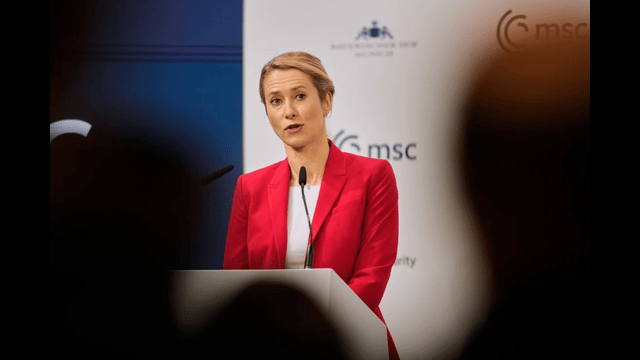
European Union foreign policy chief Kaja Kallas speaks during the Munich Security Conference in Munich, Germany, Sunday, Feb. 15, 2026.
European leaders pushed back strongly after U.S. criticism suggested the continent risks “civilizational erasure.”
The sharp response came during discussions on security, alliances, and shared democratic values.
Officials stressed that Europe remains stable, attractive, and committed to global cooperation despite policy disagreements.
EU Leader Challenges ‘Civilizational Erasure’ Narrative
At the Munich Security Conference, EU foreign policy chief Kaja Kallas rejected the controversial claim directly.
She argued that Europe is not declining culturally or politically, despite recent criticism from Washington.
Instead, she insisted the European Union continues attracting global interest and new partnerships.
Kallas noted that people worldwide still want closer ties with Europe.
She even recalled conversations abroad about potential EU membership interest.
Such examples, she said, contradict claims of weakening identity or social collapse.
US Strategy Sparks European Concern
The dispute follows language in a recent U.S. national security strategy.
The document warned that Europe faces economic stagnation and possible cultural decline.
It blamed immigration policies, low birth rates, and political tensions for the perceived risks.
The strategy also mentioned concerns about free speech limits and fading national identities.
European officials viewed these claims as exaggerated and politically charged.
Kallas described the accusations as unfair criticism and unnecessary “European-bashing.”
She emphasized that Europe continues defending human rights and democratic principles.
According to her, those commitments help maintain prosperity and social stability.
Rubio Signals Cooperation but Stands Firm
U.S. Secretary of State Marco Rubio addressed the same conference with a calmer tone.
His remarks contrasted with earlier comments from Vice President JD Vance, who previously criticized European policies more sharply.
Rubio reassured allies that Washington does not want to end trans-Atlantic cooperation.
He stressed that the United States still values its historical connection with Europe.
However, he confirmed the administration will continue pushing its priorities.
Those priorities include stricter migration positions, trade adjustments, and climate policy changes.
This signals that policy friction between Washington and European capitals will likely continue.
Europe Defends Its Social Model
European leaders responded by reaffirming their commitment to openness and diversity.
British Prime Minister Keir Starmer strongly defended multicultural democratic societies.
He argued that diversity strengthens nations rather than weakening them.
Starmer said different communities living peacefully together demonstrate democratic resilience.
He described inclusive societies as a strategic strength in modern geopolitics.
His message aligned closely with broader EU leadership views.
Shared Alliance, Different Policies
Despite disagreements, European officials acknowledged the enduring alliance with the United States.
Kallas highlighted that both sides remain deeply interconnected historically and strategically.
Security cooperation and economic partnerships continue to bind the regions together.
Still, she admitted policy differences will persist across several global issues.
These include climate approaches, speech regulations, migration frameworks, and trade policies.
She suggested both sides must work pragmatically despite those differences.
Future of Trans-Atlantic Relations
The debate highlights growing tension within the Western alliance’s evolving structure.
Washington seeks policy shifts, while European leaders defend their institutional models.
Yet neither side appears ready to abandon cooperation entirely.
For now, European officials continue rejecting the “civilizational erasure” narrative firmly.
They argue Europe remains politically influential, economically relevant, and socially resilient.
Ongoing dialogue suggests the partnership will adapt rather than fracture.
The conference ultimately showed one clear reality.
The trans-Atlantic relationship faces friction, but still stands firmly in place.