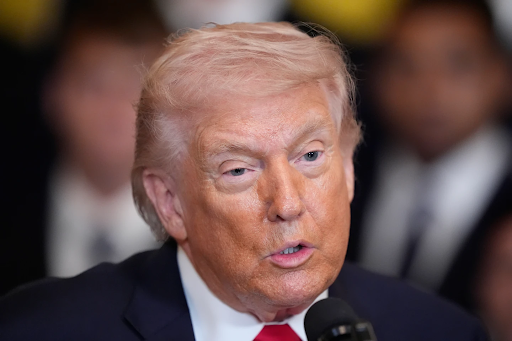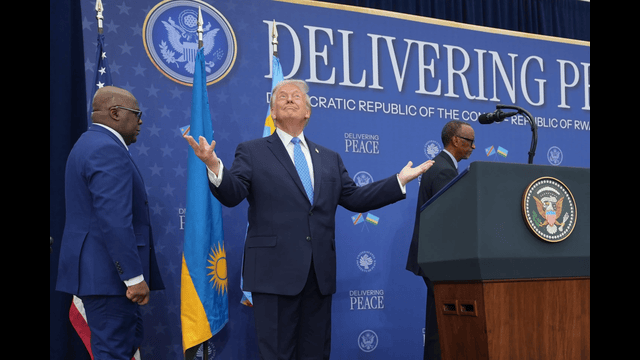
President Donald Trump arrives for a signing ceremony with Rwanda’s President Paul Kagame and Democratic Republic of Congo President Felix-Antoine Tshisekedi at the Donald J. Trump Institute of Peace, Thursday, Dec. 4, 2025, in Washington.
A new Congo–Rwanda peace deal, signed in Washington and praised by former U.S. President Donald Trump, aims to curb fighting in eastern Congo and expand American access to the region’s critical minerals. Despite the ceremony’s optimism, violence continues across the conflict zone, raising questions about how quickly the Trump-mediated peace agreement can reshape realities on the ground.
Trump Celebrates Deal as a Diplomatic Victory
Trump welcomed Congo’s President Felix Tshisekedi and Rwanda’s President Paul Kagame for the signing ceremony, calling the agreement a major breakthrough. He described the moment as a “great day for Africa” and claimed the U.S. had succeeded “where others failed.”
The White House touted the pact as historic. It follows months of negotiations involving the U.S., the African Union, and Qatar, building on an initial framework agreed upon in June.
Trump used the event to highlight his record as a global dealmaker and again hinted at his desire for a Nobel Peace Prize, a topic he has raised repeatedly.
Conflict in Eastern Congo Still Rages
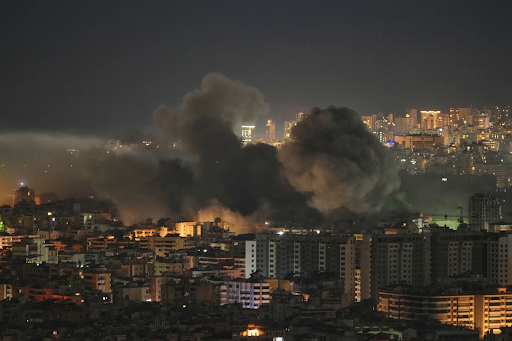
Even as leaders praised the new pact, fighting in eastern Congo continued. The region has long suffered from clashes involving more than 100 armed groups, including the Rwanda-backed M23 rebels.
M23 made major territorial gains earlier this year, capturing the cities of Goma and Bukavu. These advances deepened one of the world’s largest humanitarian crises, displacing millions.
Residents say the situation hasn’t improved despite the new diplomatic push. “We are still at war,” said Amani Chibalonza Edith, a resident of Goma. “There can be no peace while front lines remain active.”
Leaders Offer Hope, but Trust Remains Fragile
Both Kagame and Tshisekedi voiced cautious optimism during the ceremony. Kagame said no one had asked Trump to intervene, but he praised the effort. Tshisekedi called the deal “the beginning of a demanding new path.”
Still, the strain between the two leaders was visible. They did not shake hands or exchange more than brief glances during the 50-minute event. Analysts warn the agreement won’t deliver immediate peace, especially since a separate pact involving M23 also remains untested.
Rare Earth Minerals at the Heart of the Deal
Beyond peace, the agreement expands economic cooperation and opens pathways for the U.S. to access critical minerals in the region. These include rare earth elements essential for fighter jets, cell phones, and other advanced technologies.
Trump announced new bilateral agreements that will bring major U.S. companies into Congo and Rwanda. He suggested the deal would benefit all parties economically, while helping Washington reduce reliance on China, which dominates global rare earth mining and processing.
The peace pact also builds on a Regional Economic Integration Framework, designed to guide partnerships involving Congo, Rwanda, and the U.S.
Violence, Humanitarian Strain, and U.S. Funding Cuts
On the ground, eastern Congo remains volatile. Clashes continue across South Kivu and other zones despite earlier ceasefire commitments. Both M23 fighters and Congolese forces accuse each other of violating agreements.
Conditions in rebel-held Goma have worsened due to U.S. aid cuts, leaving residents without critical support. The local airport remains closed, banking services are suspended, and crime rates and food prices have soared.
A Conflict Rooted in Decades of History
The current tensions trace back to the 1994 Rwandan genocide, after which nearly two million Hutus fled into Congo. Rwanda claims some of these groups remain active militias threatening Tutsi populations.
Congo insists peace cannot be permanent unless Rwanda withdraws its support for M23. Rwanda denies backing the rebels but argues that some Congolese militias, aligned with the national army, remain a threat.
U.N. experts estimate that 3,000 to 4,000 Rwandan troops operate inside eastern Congo alongside M23, though Kigali rejects the allegation.
A Fragile Peace Amid Uncertain Outcomes
Trump predicted the deal would bring “a new era of harmony.” But the lack of trust between Congo and Rwanda, combined with ongoing violence and economic pressures, suggests that real peace will take more than signatures.
For now, the Congo–Rwanda peace deal stands as a symbolic step—one celebrated in Washington, yet challenged by gunfire, displacement, and instability still unfolding across eastern Congo.