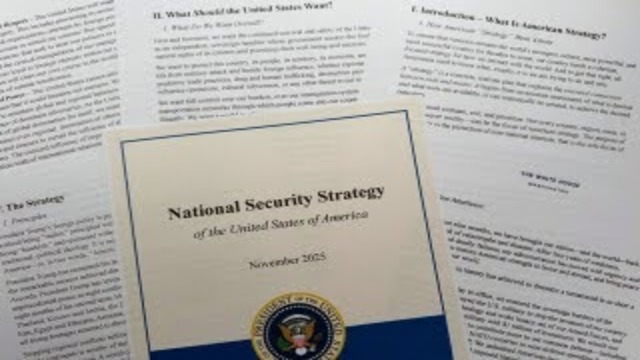
The National Security Strategy, released in November 2025, is photographed Wednesday, Dec. 10, 2025. Associated Press
A major shift is underway in Washington as Congress pushes forward with strong measures targeting China, even as the Trump administration softens its public tone to maintain economic stability. A sweeping 3,000-page National Defense Authorization Act (NDAA) passed by the House introduces new barriers to U.S. investments in China and tighter controls on biotechnology ties between the two countries.
The bill now heads to the Senate, where additional debate is expected.
Congress Tightens Its Stance on China
The NDAA would restrict American investments that could support China’s military modernization, particularly in next-generation technologies. It also bans federal funds from being used to purchase equipment or services from blacklisted Chinese biotech companies, an industry viewed as increasingly intertwined with defense and national security.
The bill further expands U.S. backing for Taiwan, a move China fiercely opposes. Increased cooperation would include major funding boosts and new joint defense programs.
Rep. Raja Krishnamoorthi said these combined steps show a “serious, strategic approach to countering the Chinese Communist Party.”
A Harsher Direction Than the White House
The aggressive congressional posture comes just days after the White House released its national security strategy with softer language on China. The document removed terms describing China as a long-term strategic threat, instead signaling a desire to “rebalance” economic ties rather than fuel confrontation.
The administration also approved Nvidia’s sale of an advanced computing chip to China—an action critics say strengthens Chinese AI capabilities.
Defense analysts say the contrast is striking. According to Craig Singleton of the Foundation for Defense of Democracies, Congress is creating “a hard-edged, long-term competition with Beijing” regardless of White House messaging.
Beijing condemned the bill immediately, calling it an attempt to “play up the China threat” and interfere with internal affairs, including Taiwan.
U.S. Investments in Chinese Tech Under Tight Review
Lawmakers have long attempted to regulate U.S. capital flows into Chinese sectors involving quantum computing, AI, semiconductors, and aerospace. Previous efforts stalled, partly due to opposition from major business leaders such as Elon Musk, whose Tesla operations in Shanghai remain vital to the company’s global strategy.
This time, the investment-screening provision secured a place in the must-pass defense authorization bill, giving Congress the leverage it lacked before.
Rep. John Moolenaar applauded the change, arguing that American retirees’ and investors’ money should not “build up China’s military and economy.”
Biosecurity Section Strengthens U.S. Protections
A revised version of last year’s failed BIOSECURE Act also appears in the NDAA. Instead of naming specific companies, the bill directs the Office of Management and Budget to create an updated list of “biotechnology companies of concern.”
The Pentagon would also expand investments in U.S. biotechnology to secure supply chains and protect genetic data from misuse.
Supporters say the approach reduces risk without stifling pharmaceutical innovation.
Expanding U.S. Support for Taiwan
Taiwan emerges as a major focus. The bill calls for:
- Increasing security cooperation funding from $300 million to $1 billion
- Establishing a joint drone and anti-drone program with the Pentagon
- Supporting Taiwan’s bid to join the International Monetary Fund
These moves come as President Trump seeks trade agreements with President Xi Jinping and attempts to avoid inflaming tensions unnecessarily. Beijing considers Taiwan a core national interest and warns against foreign involvement.
The White House insists it does not support any unilateral change in the Taiwan Strait status quo, but stresses that the U.S. cannot manage regional deterrence alone. The strategy urges key allies—Japan and South Korea—to increase defense spending.
A New Phase in U.S.–China Relations
If the Senate approves the NDAA, the U.S. will enforce some of its toughest restrictions yet on Chinese technology, biotech, and military-related economic ties. It would also deepen support for Taiwan at a sensitive geopolitical moment.
Overall, Congress is signaling that U.S.–China competition is entering a more permanent phase, one that future administrations may find difficult to reverse.