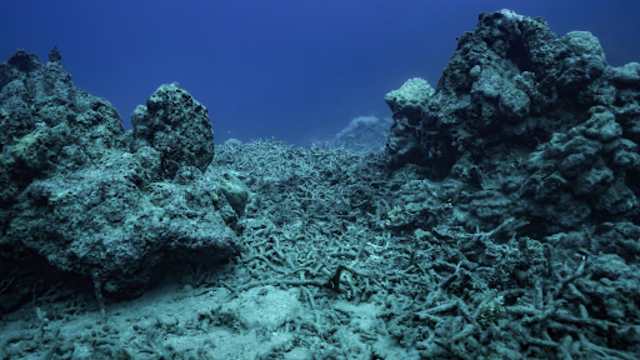
What was once a colourful coral reef at Havannah Harbour near Efate Island in Vanuatu is now a lifeless coral graveyard after being hit by several natural disasters, Sunday, July 20, 2025. (AP)
The world’s tropical coral reefs have likely passed a crucial threshold of survival, according to a major scientific report released Monday. The study warns that rising ocean temperatures have pushed coral ecosystems beyond their ability to recover, marking the first time researchers have declared such a global “tipping point.”
Lead author Tim Lenton, a climate and Earth system scientist at the University of Exeter, said the findings signal a major and possibly irreversible shift in marine life. “Sadly, we’re now almost certain that we crossed one of those tipping points for warm water or tropical coral reefs,” Lenton said.
A Planet at the Edge of Change
Scientists define a tipping point as a threshold after which natural systems undergo large, often permanent changes. The report, compiled by 160 researchers from around the world, found that this stage has already begun for coral reefs.
Since the first comprehensive study of tipping points in 2023, global ocean temperatures have soared to record highs. The result has been the most severe coral bleaching event in history, affecting over 80 percent of reefs across the planet.
Bleaching happens when corals expel the microscopic algae that give them their bright colours and essential nutrients. Without these algae, corals starve and die unless temperatures quickly cool. But with oceans staying warmer for longer, many reefs are no longer recovering.
Mass Coral Die-Offs Recorded Worldwide
The report found that even with 1.4°C of global warming, coral reefs are already suffering “unprecedented dieback.” Scientists previously believed most reefs would vanish only at 1.5°C of warming — a limit the world is expected to reach within the next few years.
Across the Pacific, Indian, and Atlantic Oceans, marine scientists have documented widespread coral death, turning once-vibrant reefs into ghostly white skeletons. “We can no longer talk about tipping points as a future risk,” said Lenton. “They’re happening now.”
Instead of vanishing completely, many reefs are transforming into simpler ecosystems dominated by algae, sponges, and other heat-resistant organisms. Over time, dead coral skeletons crumble into rubble, erasing centuries of reef formation.
This transformation will have devastating effects on more than a million marine species that rely on coral reefs for food and shelter — and on hundreds of millions of people whose livelihoods depend on fishing and tourism linked to these ecosystems.
Beyond Coral: Other Systems at Risk
The report also warned that other natural systems are nearing collapse. The Amazon rainforest could face widespread dieback at lower temperatures than previously thought, while ice sheets in Greenland and West Antarctica could melt faster, raising global sea levels.
Exceeding 1.5°C of warming could also disrupt major ocean currents, leading to “catastrophic” consequences for global climate systems, Lenton said.
Still, scientists see some hope. The rapid growth of solar energy and electric vehicles represents what Lenton called “positive tipping points” — moments when change can accelerate in the right direction. “It gives us agency back,” he said. “We can still make a tangible difference.”