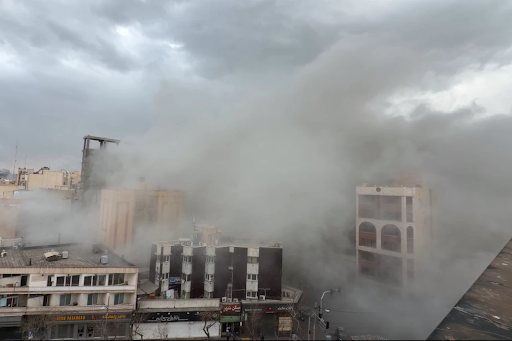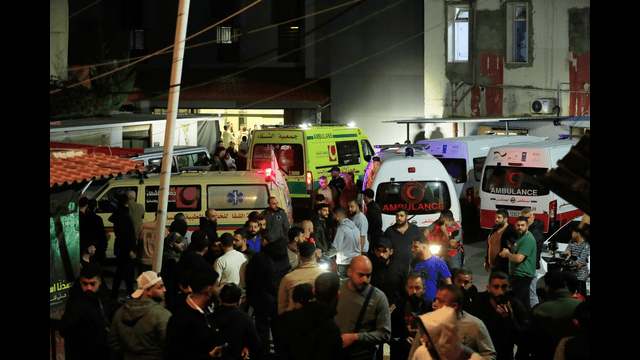
People gathering next of ambulances outside a hospital where they brought the victims of the Israeli strike that hit the Ein el-Hilweh refugee camp in the southern port city of Sidon, Lebanon, Tuesday, Nov. 18, 2025.
Thirteen people were killed on Tuesday after an Israeli airstrike hit the crowded Ein el-Hilweh Palestinian refugee camp in southern Lebanon. Several others were wounded, marking the deadliest attack in Lebanon since the Israel-Hezbollah ceasefire last year.
Strike Targets Refugee Camp in Sidon
According to Lebanon’s state-run National News Agency, the Israeli drone strike hit a car in the parking lot of a mosque inside the camp near Sidon’s coastal outskirts.
The Lebanese Health Ministry confirmed the death toll but did not release identities or further medical details.
Rescue teams rushed into the camp, but Hamas fighters restricted journalist access, complicating independent verification of the damage. Ambulances ferried victims out as chaos unfolded in the tightly packed neighborhood.
Israel Claims It Hit a Hamas Training Site
The Israeli military said the strike targeted a Hamas training compound, claiming the group was preparing an attack against Israeli forces.
Israel vowed to continue operations against Hamas “wherever the group operates,” signaling an ongoing regional confrontational posture.
Hamas Rejects Israel’s Explanation
In a statement, Hamas condemned the airstrike and denied the Israeli claim. The group insisted the area hit was a sports playground, not a military facility.
The latest violence deepens concerns about renewed instability in southern Lebanon, where multiple armed groups operate inside densely populated refugee camps.
Escalating Pattern of Strikes in Lebanon
The airstrike adds to a growing list of targeted killings in Lebanon over the past two years. Israeli attacks have killed numerous members of Hezbollah and Palestinian factions, including senior Hamas figures.
One of the most significant assassinations was the January 2024 drone strike that killed Saleh Al-Arouri, Hamas’ deputy political chief, in Beirut’s southern suburbs. Several Hamas officials have been killed since amid Israel’s intensified regional campaign.
Conflict Roots: From Oct. 7 to Regional Spillover
Hamas’ Oct. 7, 2023 attack on southern Israel, which killed about 1,200 people, triggered Israel’s large-scale offensive on Gaza. The Gaza Health Ministry has reported tens of thousands of Palestinian deaths since then.
A day after the war began, Hezbollah launched rocket attacks across the border into northern Israel. Israel retaliated with shelling and airstrikes, fueling an escalating conflict that grew into a full-scale war by September 2024.
War Devastates Lebanon
The 2024 war was one of Lebanon’s most destructive in decades. More than 4,000 people were killed, including hundreds of civilians. The World Bank estimated damages at $11 billion, overwhelming a country already mired in economic collapse.
In Israel, 127 people were killed during the conflict, including 80 soldiers.
The war formally ended in late November 2024 after a U.S.-brokered ceasefire. Yet cross-border tensions remained high, with Israel continuing strikes to prevent what it calls Hezbollah’s efforts to rebuild military capacity.
Rising Toll After Ceasefire
Despite the truce, Lebanon’s Health Ministry says over 270 people have been killed and around 850 wounded by Israeli military actions since late 2024.
Tuesday’s fatal airstrike at the Ein el-Hilweh refugee camp adds to this toll and raises fears of destabilization in an already fragile region.
As international observers warn of a possible escalation, Lebanon continues to grapple with the aftermath of prolonged conflict—where each new attack risks pulling the region back toward war.