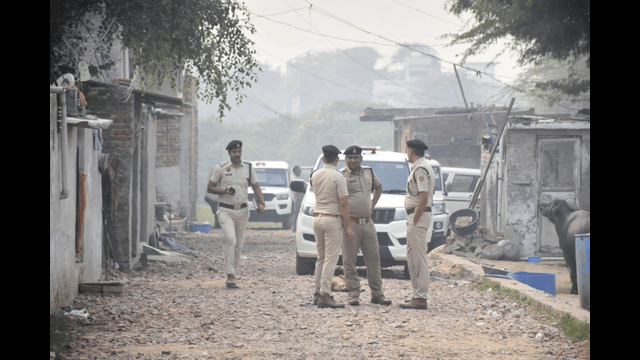
Security officials stand outside a house at Fatehpur Tagga, in Faridabad on the outskirts of New Delhi, India, Monday, Nov. 10, 2025.
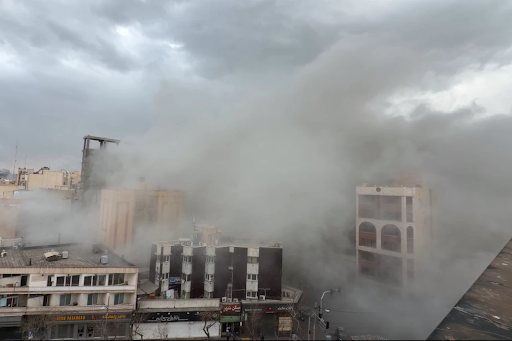
The Indian government has termed a deadly car blast in Delhi a terror attack orchestrated by “anti-national forces.” Investigators are exploring links to suspects from Kashmir, as authorities tighten security amid fears of renewed India-Pakistan tensions.
Investigations Point Toward Kashmiri Suspects
Police interrogations over the past three weeks have led to the detention of two Kashmiri doctors working in different Indian cities and two additional suspects from the region. Authorities believe the group may be part of a coordinated cell operating across state lines.
Local media reports suggest that the car’s driver, possibly another Kashmiri doctor teaching at a medical college in Faridabad, was either transporting explosives or deliberately triggered the blast to evade arrest. However, police have not officially confirmed this detail.
Delhi Police spokesperson Sanjay Tyagi said investigators were probing “all possible angles, including terrorism, an accidental explosion, or a mechanical failure.”
Missing Doctor’s Family Questioned
In Pulwama district of Kashmir, the family of the missing doctor—believed to be connected to the explosion—said they had lost contact with him days before the incident.
“He called us on Friday and said he would return home in three days,” recalled his sister-in-law Shagufta Jan. “That was the last time we heard from him.”
She added that police visited their home on Monday night, taking the doctor’s mother and two brothers for questioning. Authorities have yet to release an official statement about their interrogation or the doctor’s whereabouts.
Blast Rekindles India-Pakistan Tensions
The potential terrorism link has once again stirred political and military tensions between India and Pakistan, both nuclear-armed neighbors with a long history of conflict over Kashmir.
New Delhi has frequently accused Islamabad of backing cross-border militant activities, while Pakistan continues to deny the allegations. The Indian government maintains that militant attacks in its territory are Pakistan-sponsored terrorism, while many in Kashmir view the movement as a freedom struggle against Indian rule.
Earlier this year, 26 civilians, mostly Hindu tourists, were killed by suspected militants in Indian-administered Kashmir. India blamed Pakistan for the attack, prompting tit-for-tat airstrikes that nearly pushed the two countries to the brink of another war.
Kashmir: A Region on Edge
Both nations control parts of Kashmir but claim the territory in full. The region has remained a flashpoint since 1947, witnessing continuous insurgencies and cross-border clashes.
Since 1989, militant groups have fought against Indian administration in the region. Despite heavy security deployments, sporadic violence continues to erupt, often leading to civilian casualties and military standoffs.
The latest car blast threatens to deepen the existing mistrust between the two nations, even as diplomatic efforts for peace remain fragile.
A History of Bombings in the Capital
Delhi has faced several major terror attacks over the decades. In 1996, a powerful car bomb ripped through the busy Lajpat Nagar market, killing 13 people. Later, in 2008, coordinated blasts across shopping districts claimed around 20 lives.
Investigations into both incidents pointed toward Kashmiri militant organizations and an Indian Islamist student group. The recurrence of similar attacks has prompted security agencies to tighten surveillance across major Indian cities.
Government’s Stand on the Blast
The Indian government has reaffirmed its commitment to combating terrorism and ensuring national security. Officials say the explosion reflects a “continued attempt by anti-national forces to destabilize India.”
Security has been heightened across Delhi and Jammu & Kashmir, while intelligence agencies coordinate with local police to track any remaining members of the suspected terror network.
As investigations continue, India braces for the possibility that the car blast could mark the return of urban terrorism—a grim reminder of a violent past that the nation is still striving to overcome.