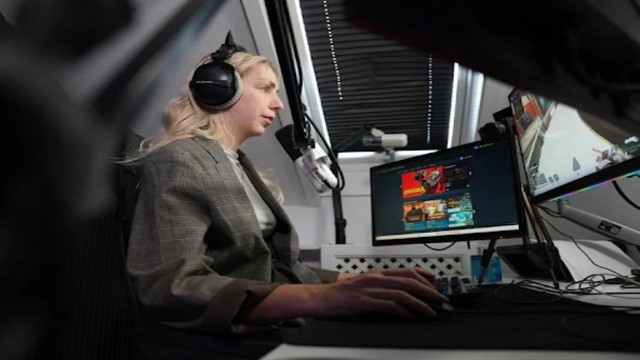
Danish video game live-streamer Marie Watson, 28, plays a video game in her studio in Taastrup, Denmark, Thursday, Oct. 9, 2025. (AP Photo)
Denmark is preparing to take a landmark step against the growing menace of deepfakes — artificial intelligence-generated images, videos, and voices that can mimic real people with alarming accuracy. A new law, expected to pass early next year, aims to protect citizens’ likenesses from being used without consent.
The proposal comes as cases of digital impersonation rise worldwide, leaving victims powerless against technology’s dark turn.
A Disturbing Personal Experience
In 2021, Danish video game live-streamer Marie Watson learned how devastating deepfakes can be. She received an image from an unknown account — a familiar photo from her Instagram, but digitally altered to remove her clothes.
“It overwhelmed me,” Watson recalled. “I burst into tears. It felt like I had been stripped of control.”
Her experience was an early warning of what would soon become a global problem. In just four years, deepfakes have evolved from a fringe novelty to a mainstream threat. The rapid growth of generative AI tools — including those from major tech firms — now allows anyone to create shockingly realistic fake content in seconds.
Protecting Identity and Dignity
Denmark’s proposed law seeks to amend copyright regulations to give citizens ownership of their own likeness — their face, voice, and image. That means anyone sharing deepfakes without consent could be breaking the law.
The move would empower individuals to demand that online platforms remove fake or manipulated media. Exceptions for parody and satire would remain, though experts say drawing that line may prove complex.
Officials describe the legislation as one of Europe’s boldest efforts to protect personal identity in the digital era. Danish Culture Minister Jakob Engel-Schmidt said the new rules are necessary to preserve both truth and trust online.
“If a politician can be deepfaked without the right to have it taken down, democracy suffers,” Engel-Schmidt said at a recent conference.
A Growing Global Concern
Deepfakes have already drawn international attention. In the U.S., a bipartisan law signed earlier this year criminalizes the publication of intimate deepfake images without consent. South Korea has also introduced strict penalties for deepfake pornography and forced social media platforms to strengthen monitoring.
Experts say Denmark’s proposal reflects a growing global recognition that traditional laws no longer match the pace of AI innovation.
Henry Ajder, a leading voice on generative AI ethics, praised Denmark’s initiative. “Right now, there’s little individuals can do to protect themselves,” he said. “You can’t just erase your online presence. That’s not realistic.”
He added that protecting identity in the digital age requires rethinking fundamental rights. “We can’t treat this as business as usual,” Ajder noted. “Our sense of dignity depends on it.”
Tech Platforms Under Pressure
While the Danish law wouldn’t punish individual users with fines or jail, major online platforms could face severe penalties if they fail to act on takedown requests. Engel-Schmidt said the intent is to push companies like Meta, Google, and TikTok to take more responsibility.
Industry experts point to YouTube as an example of a platform taking copyright and identity protection seriously. Yet others argue that voluntary measures aren’t enough.
Maria Fredenslund, director of the Danish Rights Alliance, said existing regulations leave victims exposed. “When we report AI voice clones or fake images, platforms ask which law applies,” she said. “Right now, we don’t have one.”
The Human Cost of Digital Abuse
For victims like Watson, new laws can’t come soon enough. She has since learned that manipulated images of herself and other women continue to circulate online — often traded or sold in dark web communities.
“It’s terrifying how easy it is,” she said. “You just search ‘deepfake generator’ and dozens of sites appear. It takes minutes.”
While Watson welcomes Denmark’s push for reform, she believes responsibility lies equally with tech giants. “It shouldn’t be possible to upload such content at all,” she said. “Once it’s online, you’re done. You can’t control it.”
As Denmark prepares to pass one of the world’s toughest deepfake laws, its message is clear — protecting digital dignity is no longer optional.