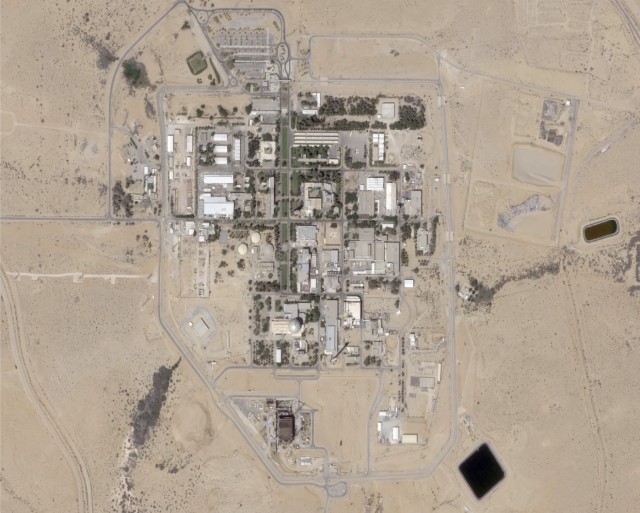
This satellite photo provided by Planet Lab PBC shows the shemon pears Negev nuclear research center near the city of Dimona, Israel, July 5, 2025.
Construction activity has sharply increased at Israel’s Dimona nuclear site, long suspected to be linked to its secretive nuclear weapons program. New satellite images analyzed by nuclear experts reveal significant underground work, fueling speculation about Israel’s atomic ambitions.
Rising Activity at Dimona Nuclear Site
The Shimon Peres Negev Nuclear Research Center, located near the city of Dimona, is at the center of renewed scrutiny. Images captured on July 5 show intensified construction, including cranes, deep excavations, and concrete retaining walls. The site appears to include multiple underground levels.
Experts say this work could mark the construction of a new heavy water reactor or possibly a facility for assembling nuclear arms. Either way, the secrecy surrounding Dimona makes it impossible to confirm.
Possible Reactor or Weapons Facility
Seven nuclear analysts reviewed the satellite images. Three believe the scale and design suggest a new heavy water reactor, capable of producing plutonium — a key ingredient for nuclear weapons. The remaining four experts say it might also be a weapons assembly plant.
Jeffrey Lewis, a leading nonproliferation scholar, stated, “It’s probably a reactor. Based on its location and structure, it’s difficult to imagine otherwise.”
Israel’s Nuclear Ambiguity Policy
Israel has never confirmed nor denied possessing nuclear weapons, maintaining a policy of deliberate ambiguity. However, experts and past whistleblower revelations suggest Israel may have built dozens of warheads since the 1980s.
This silence continues. Both the Israeli government and the White House, Israel’s closest ally, declined to comment on the new construction.
Dimona Reactor’s Long Life
Dimona’s existing heavy water reactor, operational since the 1960s, has already surpassed its expected lifespan. Analysts believe the aging reactor either needs replacement or major upgrades. The new construction may serve as a modern substitute.
Unlike typical reactors, the new structure lacks a visible containment dome. Some experts suggest Israel could be building a box-shaped reactor without the dome, or it may be added later.
Strategic Importance of Heavy Water Reactors
Israel, like India and Pakistan, is believed to rely on heavy water reactors to fuel its nuclear arsenal. Such reactors produce plutonium and tritium, both essential materials for nuclear weapons.
Tritium, which enhances the destructive yield of warheads, decays by around 5% each year. Analysts suggest that obtaining fresh tritium could be one motive behind the Dimona expansion.
“If they’re building a new reactor, it may be to replace tritium, not necessarily to expand plutonium production,” explained Edwin Lyman of the Union of Concerned Scientists.
Global Context and Rising Tensions
The timing of Israel’s nuclear-linked construction raises questions globally. It follows Israeli and U.S. airstrikes in June targeting Iranian nuclear facilities, including Iran’s Arak heavy water reactor. These strikes highlighted Western fears of Iran’s potential nuclear ambitions, even as Israel’s own program remains unacknowledged and uninspected.
Outside International Oversight
Unlike most nuclear-armed nations, Israel is not a signatory to the Nuclear Nonproliferation Treaty. This means the International Atomic Energy Agency (IAEA) has no mandate to inspect the Dimona facility. The IAEA recently clarified that Israel is not obligated to disclose details about such nuclear projects.
How Many Weapons Does Israel Have?
The secrecy around Israel’s nuclear program makes accurate estimates nearly impossible. However, the Bulletin of the Atomic Scientists estimated in 2022 that Israel possesses around 90 nuclear warheads.
Daryl G. Kimball of the Arms Control Association warns that if the new Dimona project is indeed a reactor, Israel may be maintaining its existing arsenal while ensuring the ability to produce new warheads.
A Legacy of Secrecy
Israel began developing its nuclear program in the 1950s, shortly after multiple wars with neighboring states. Ever since, nuclear ambiguity has served as both a shield and deterrent.
Yet, as new images reveal expanding construction at Dimona, experts agree on one point — Israel is preparing for the future of its nuclear arsenal, even if the exact purpose remains a mystery.