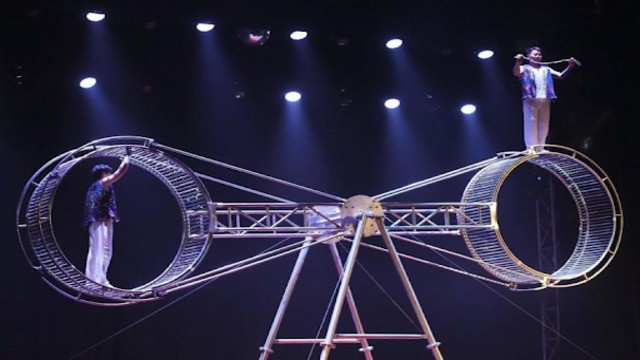
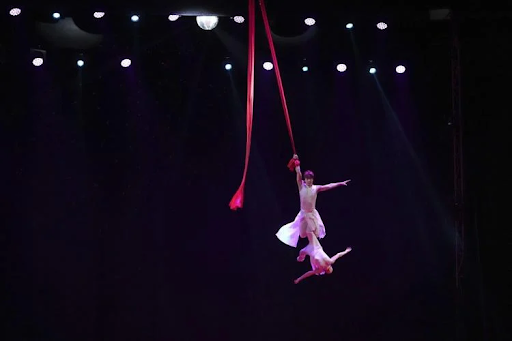
Acrobats from Dongchoon Circus Troupe, South Korea’s last remaining circus, in Ansan, South Korea, June 11, 2025. (AP Photo)
Amid the roar of applause under a seaside big top, Dongchoon Circus stands tall. It’s not just any performance—it’s the 100th year of South Korea’s only surviving circus. No elephants, no motorcycle stunts. Just pure, old-school acrobatics keeping a fading art alive.
Acrobats soared on silks, juggled atop spinning wheels, and balanced on tightropes, thrilling the crowd. Yet behind the applause lies a struggle to preserve one of Korea’s oldest performing art traditions.
A Century of Grit and Grace
Dongchoon was founded in 1925, long before TVs or smartphones. In the 1960s, it travelled nationwide, entertaining towns with exotic animals, comedic skits, magic, and song. Back then, it had over 200 performers. Today, that legacy rests on the shoulders of a much smaller team—and a single man determined to keep it alive.
Park Sae-hwan, now 80, joined Dongchoon in 1963. He performed, sang, hosted shows—and eventually left to run a supermarket. But when a typhoon nearly destroyed the circus in 1978, he returned. He bought it, determined not to let it vanish.
“I thought Dongchoon must not disappear,” he says. “It holds the roots of our traditional performances, dramas, and magic shows.”
The Circus Vanishes—Then Survives
Over the decades, Dongchoon faced major setbacks. TV, internet, video games, and movies chipped away at audiences. Performers moved on to television careers. Animal acts were phased out due to animal rights concerns. And finally, other South Korean circuses folded—until Dongchoon stood alone.
In 2009, flu outbreaks emptied the tents. Park considered shutting down. But when the media highlighted the circus’s struggle, audiences returned in droves, packing the seats for weeks.
A New Home, A Fresh Start
Since 2011, Dongchoon has operated from a seaside tent in Ansan, just south of Seoul. The location boosted its fortunes. Weekdays bring in hundreds, weekends up to 2,000. Tourists flock to the area not just for the sea, but for a taste of nostalgia—and something refreshingly different.
“Older generations come to relive memories. Young ones come because it’s new,” says local official Sharon Ham.
Tradition with a Modern Twist
Gone are the risky stunts and animal acts. Today, the circus focuses solely on acrobatics. But there’s another big shift: all 35 acrobats are now Chinese. Few South Koreans pursue the circus life anymore—it’s seen as too dangerous and low-paying.
Performance director Xing Jiangtao, who joined in 2002, remembers training under 50 South Korean acrobats. “Now, they’re all gone,” he says. “But we continue, and we hope Dongchoon lives another 100 years.”
Park dreams of building a circus school on land he’s bought in Ansan. His mission: to pass the baton and train the next generation of South Korean circus performers.
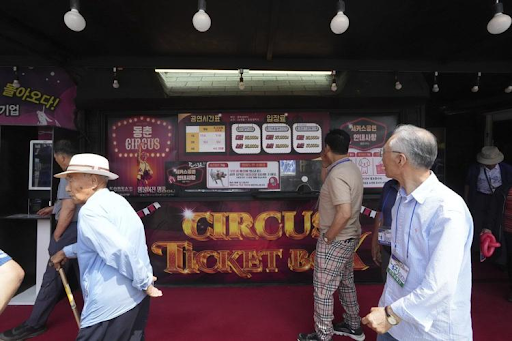
Spectators exit Dongchoon Circus in Ansan after the show, June 2025. (AP Photo)
Dongchoon Circus - More Than a Show
For many, Dongchoon isn’t just a circus. It’s a living piece of Korean culture. One expert even suggests it should be named an intangible cultural asset.
As one spectator put it, “It was amazing. But you could also see the pain behind the performance.”
Dongchoon may be the last of its kind—but it isn’t ready to take its final bow.