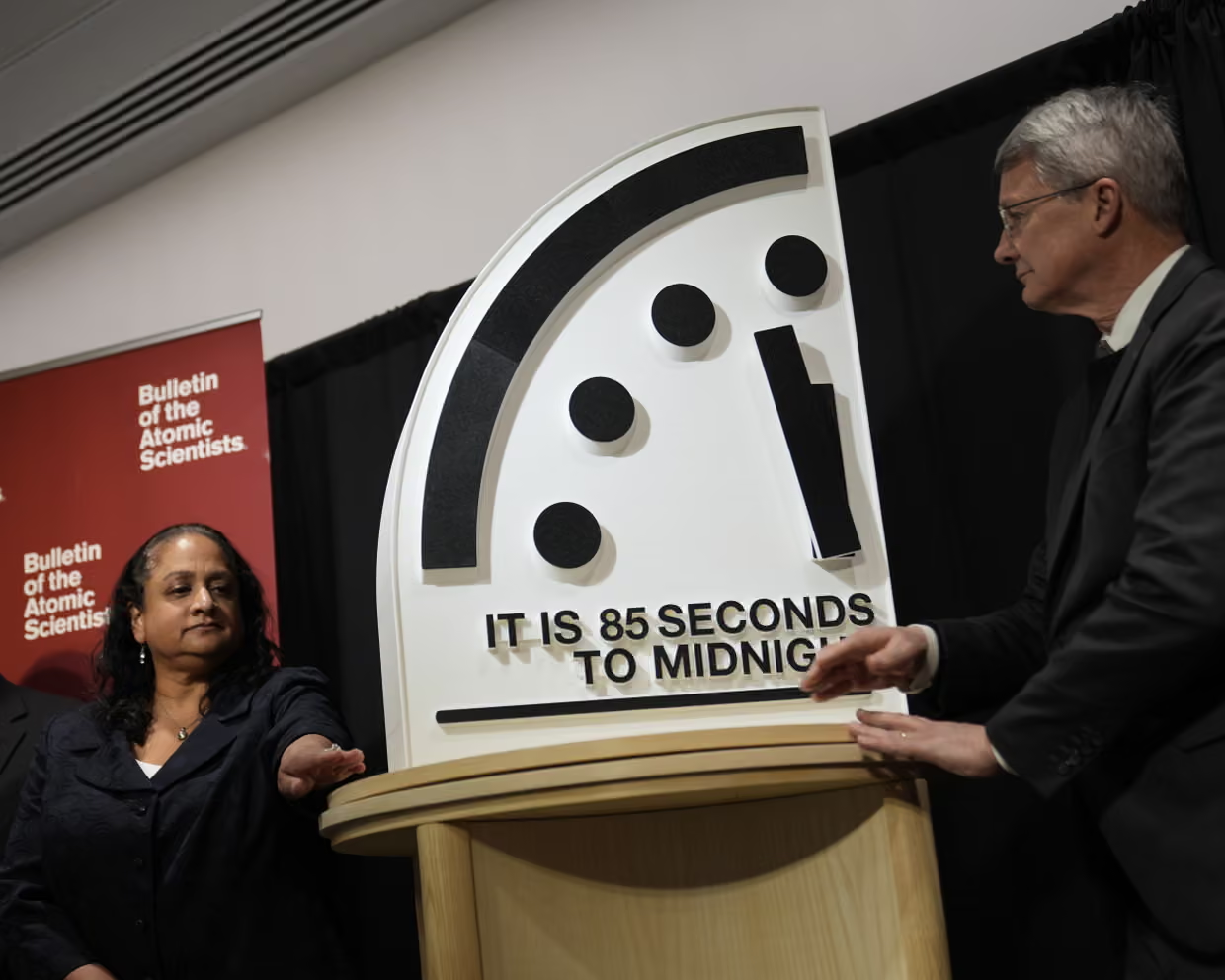
Members of the Bulletin of the Atomic Scientists display the Doomsday Clock, showing 85 seconds to midnight, during a news conference held in Washington, D.C., on Friday. AP Photo
Earth now stands closer to disaster than ever before, according to a leading science-focused advocacy group. On Tuesday, the Bulletin of the Atomic Scientists moved its symbolic Doomsday Clock to just 85 seconds before midnight. The change reflects rising global dangers linked to conflict, climate change, and fast-moving technology.
The group first shared a preview of its findings on Friday before releasing the full announcement days later. Last year, the clock stood at 89 seconds to midnight. The latest shift marks a troubling step closer to what the group views as a global breaking point.
Rising Tensions Drive the Decision
Scientists behind the clock pointed to growing hostility among major world powers. They warned that countries such as Russia, China, the United States, and others have become “increasingly aggressive, adversarial, and nationalistic.”
These tensions weaken global cooperation at a time when joint action matters most. The group said long-standing agreements that once reduced global risks have started to fall apart, creating a climate of competition rather than collaboration.
Nuclear Conflict Remains a Key Threat
The scientists expressed serious concern over the risk of nuclear conflict. They highlighted ongoing and recent tensions involving nuclear-armed nations, including the war between Russia and Ukraine, clashes between India and Pakistan last spring, and questions surrounding Iran’s nuclear capabilities following strikes last summer by the United States and Israel.
Such conflicts, they said, carry the risk of rapid escalation and lasting damage if diplomacy fails.
Climate and Technology Add Pressure
Beyond conflict, the group also raised alarms about worsening climate conditions. Droughts, heat waves, and floods continue to affect regions around the world. Scientists criticized the lack of strong global agreements to curb climate change and singled out efforts that favor fossil fuels over clean energy.
They also warned about the unchecked growth of new technologies. The misuse of biotechnology and the expanding role of artificial intelligence without proper safeguards add new layers of risk, they said.
Call for Cooperation
Daniel Holz, chair of the group’s science and security board, stressed the need for unity. “If the world splinters into an us-versus-them, zero-sum approach, it increases the likelihood that we all lose,” said Daniel Holz.
The group believes global trust and cooperation remain essential to reducing threats that affect everyone.
A Long-Standing Warning Symbol
The Doomsday Clock began in 1947 as a way to show how close humanity stands to self-destruction. After the Cold War, the clock moved as far back as 17 minutes to midnight. Recently, the group switched from counting minutes to seconds to reflect how quickly conditions now change.
Scientists said leaders still hold the power to turn the clock back through cooperation, restraint, and shared action.