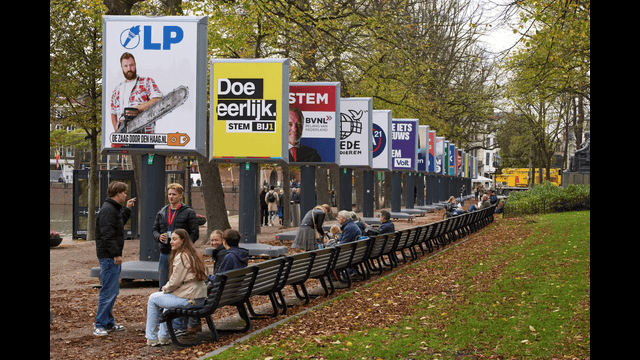
People enjoy the autumn weather next to some of the election billboards of 26 of the 27 political parties participating in the Oct 29 th general elections.
Dutch voters are heading to the polls in a tightly contested general election that could reshape the nation’s political landscape. The vote comes after weeks of intense campaigning centered on two major issues — migration and the deepening housing crisis. But one question dominates the debate: will mainstream parties work with far-right leader Geert Wilders if his Party for Freedom (PVV) secures another major win?
The election reflects growing polarization across the Netherlands, a nation of 18 million people. Tensions have escalated in recent weeks, marked by violent clashes at anti-immigration rallies and protests against new asylum centers.
Wilders’ Party Leads, but Race Remains Tight
Polls suggest that Geert Wilders’ Party for Freedom may once again claim the largest share of seats in the 150-member House of Representatives. His party’s hardline stance — calling for a total stop to asylum-seekers — continues to attract attention and controversy.
However, moderate parties are narrowing the gap. Pollsters warn that many Dutch voters often make their final choice at the last moment, keeping the race unpredictable until the very end.
Voting began at 7:30 a.m. and will close at 9 p.m., with broadcasters releasing the first exit polls immediately after. In true Dutch fashion, ballots are being cast not only in city halls and schools but also in unique locations such as churches, historic windmills, zoos, and even the Anne Frank House in Amsterdam.
Coalition Talks Loom After the Vote
Once results are in, attention will shift to coalition-building — a complex process under the Netherlands’ proportional representation system. No single party can rule alone, and alliances are key to forming a government.
Yet, most mainstream parties have ruled out partnering with Wilders. Their distrust stems from his role in collapsing the outgoing four-party coalition earlier this year, following disputes over migration policy. Many believe that move reinforced his reputation as an unreliable coalition partner.
Rivals Challenge Wilders’ Narrative
During a fiery final debate, Rob Jetten, leader of the center-left D66 party, urged voters to reject Wilders’ “grumpy hatred” and instead focus on “positive energy” to address migration challenges. Jetten emphasized balancing tighter migration controls with compassion for refugees escaping war and violence.
Frans Timmermans, who leads the joint Labor-Green Left bloc, also targeted Wilders, declaring that the election marks “the beginning of the end of the Wilders era.” His message resonated with progressive voters hoping to restore stability after months of political turbulence.
Wilders Defends His Record
In response, Geert Wilders dismissed accusations of inaction, insisting that other parties blocked his policy agenda despite his parliamentary majority. “If I had been prime minister, we would have rolled out that plan,” he argued.
Wilders previously withdrew from pursuing the prime minister’s post after the last election when potential coalition partners refused to back him. This time, however, his supporters hope for a different outcome — one where his nationalist agenda finally finds a governing foothold.
Reformist Party Faces Collapse
Meanwhile, the reformist New Social Contract (NSC) faces an uncertain future. Once a promising player with 20 seats in parliament, it now risks losing nearly all its representation. Analysts say its downfall reflects voter backlash against its decision to join a coalition with Wilders.
The departure of its popular leader, Pieter Omtzigt, in April — citing mental health reasons — further deepened the party’s decline.
A Nation at a Crossroads
As the Netherlands votes, the stakes could not be higher. With Geert Wilders again at the center of political debate, the results will reveal whether Dutch voters favor a turn toward nationalism — or a return to centrist cooperation.
Either way, coalition talks are likely to stretch for weeks, signaling that the real test of unity will begin after the ballots are counted.