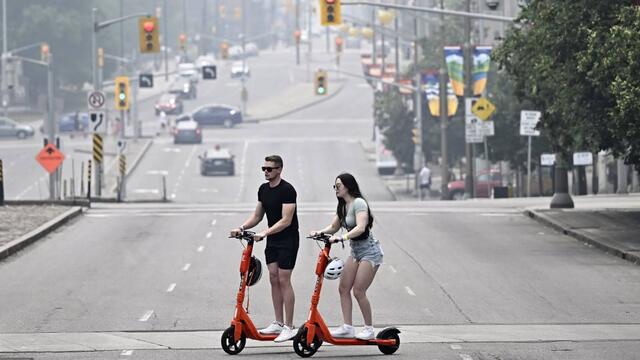
People ride e-scooters across Elgin Street in Ottawa on Sunday, June 25, 2023. (Photo: THE CANADIAN PRESS/Justin Tang)
E-scooter accidents are sending more Canadians to the hospital than ever before — and both children and adults are getting hurt. The Canadian Institute for Health Information (CIHI) has released new data showing a sharp jump in injuries tied to e-scooters, especially in Ontario, Quebec, Alberta, and British Columbia.
Over a single year, hospitalizations from e-scooter accidents rose by 32%, climbing from 375 in 2022–2023 to 498 in 2023–2024. Tanya Khan from CIHI emphasized how regulations on e-scooter use vary wildly across the country, and that this inconsistency may be fueling the issue.
Young Riders at High Risk
Kids between the ages of 5 and 17 saw a 61% rise in e-scooter-related hospital visits — from 33 to 53. Boys and men remain the most affected overall, with male hospitalizations increasing by 22% from the previous year. However, injuries among girls and women surged even more dramatically, up by 60%, jumping from 114 to 182.
The numbers suggest a troubling trend: while more people are riding e-scooters, very few seem to understand just how dangerous they can be — especially for kids.
What Doctors Are Seeing in Hospitals
Dr. Daniel Rosenfield, a pediatric emergency doctor at Toronto’s SickKids Hospital, says his team sees these injuries almost daily — and many are serious. Some are just minor scrapes or cuts, but others are far more life-threatening. From traumatic brain injuries to internal bleeding and broken bones that require surgery, the range is wide and disturbing.
One of the most heartbreaking cases involved a 13-year-old boy who died in 2023 after an e-scooter crash.
Rosenfield also noted that younger kids, even as young as four, sometimes get hurt while riding with a parent. But it’s teenagers riding alone who make up the bulk of the cases. Shockingly, 80% of injured riders weren’t wearing helmets.
More Powerful Scooters, Less Awareness
According to Rosenfield, a big part of the problem is how much more powerful and accessible e-scooters have become. Parents often buy them without realizing they’re not just toys. Some e-scooters now have enough speed and power to match motorcycles.
The real danger comes when riders crash into cars or trucks — or get hit by them. That’s when injuries go from bad to deadly.
Mixed Rules, Confused Riders
Another challenge? The patchwork of laws and rules around e-scooters.
In Ontario, riders must be 16 or older. In Toronto, riding an e-scooter on public roads is banned, but just outside the city in Oshawa, they’re allowed under a pilot program. In Vancouver, e-scooters are promoted as a green and easy way to explore the city — as long as riders are 16 or older and stay under 25 km/h.
Pamela Fuselli, head of Parachute Canada, says these inconsistent rules don’t help. Cities may set bylaws, but enforcement is weak. And even if public use is restricted, anyone can still buy an e-scooter — even for a child.
Fuselli warns parents not to buy e-scooters for children under 16. “They might look like toys,” she said, “but they’re actually motor vehicles.”
Push Scooters vs. E-Scooters: A Dangerous Difference
Dr. Rosenfield compared e-scooters to old-school push scooters, pointing out a major difference. Push scooters max out at around 5–10 km/h, and while kids can still get hurt, those injuries are rarely life-threatening.
But e-scooters are a different story. With powerful motors and high speeds, they can easily turn a fun ride into a medical emergency.