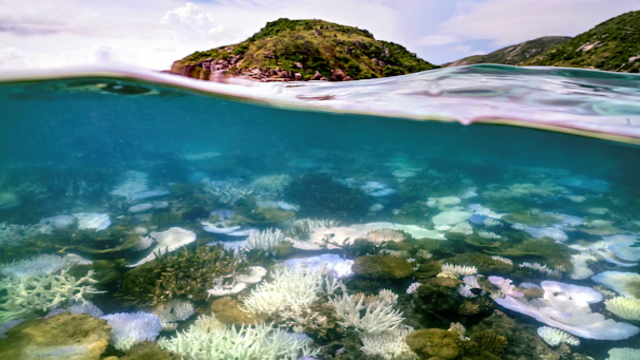
A new report warns that the planet has crossed its first major climate tipping point, with coral reefs now facing a serious and lasting decline due to rising greenhouse gas emissions. Scientists say this change threatens one of the world’s most vital marine ecosystems and could have lasting effects on ocean life and coastal communities. Getty Images
Scientists have confirmed that Earth has crossed its first catastrophic climate tipping point. Warm-water coral reefs are now in long-term decline, threatening the livelihoods of millions of people who rely on them. A new scientific report warns that this marks the beginning of irreversible damage to one of the planet’s most vital ecosystems.
The study, prepared by more than 160 researchers from around the world, says coral reefs have hit a critical threshold due to rising ocean temperatures. It warns that the world is “on the brink” of other major tipping points, including the collapse of the Amazon rainforest, the breakdown of ocean currents, and the melting of ice sheets.
Coral Bleaching at Record Levels
Since January 2023, coral reefs have faced the most severe bleaching event ever recorded. Over 80 per cent of reefs across more than 80 countries have been affected by extreme heat. Scientists say this has pushed reefs into “uncharted territory,” with many already struggling to recover.
The report estimates reefs reach their tipping point when global temperatures rise between 1°C and 1.5°C above pre-industrial levels. The planet has already warmed about 1.4°C, leaving little room for recovery. Unless temperatures fall to around 1°C, warm-water coral reefs could vanish almost entirely.
Experts Urge Urgent Action
Professor Tim Lenton from the University of Exeter says, “We can no longer talk about tipping points as a future risk. The first tipping of widespread dieback of warm water coral reefs is already under way.” He warns that millions of people who depend on reefs for food and income already feel the effects.
Reefs in the Caribbean show the fastest decline due to marine heatwaves and disease outbreaks. Lenton says these changes could lead to complete ecosystem collapse if global heating continues.
Divided Opinions Among Scientists
Not all experts agree on how dire the situation is. Professor Peter Mumby, a coral reef scientist in Australia, accepts reefs are declining but says there is evidence some can adapt. “There are reefs that could survive even at 2°C of global heating,” he says. Mumby fears people might “give up on coral reefs” too soon if they believe they are already lost.
Hope in Protection and Adaptation
Dr. Mike Barrett, a co-author of the report, stresses that protecting surviving reefs is crucial. “Conservation of reefs is now more critical than ever,” he says. Some areas, known as refugia, show lower impacts from heat and could help regrow future reefs if protected properly.
Dr. Tracy Ainsworth from the International Coral Reef Society says many reef systems are already transforming. “The future of coral reefs is one of change and reorganization,” she says. “Our challenge is to help them continue supporting marine life and local communities.”
Global Risks Grow Beyond the Oceans
The report also warns that the Antarctic and Greenland ice sheets are “perilously close” to collapse. Their melting could raise sea levels dramatically. Scientists believe global warming could exceed 1.5°C by 2030, pushing the planet into a “danger zone” with more tipping points to come.
Still, the report offers a small glimmer of hope. It notes that “positive tipping points,” such as faster adoption of clean energy and electric vehicles, could help reverse damage. “The race is on to bring forward these positive changes,” Lenton says. “If we act now, we can still avoid the worst.”