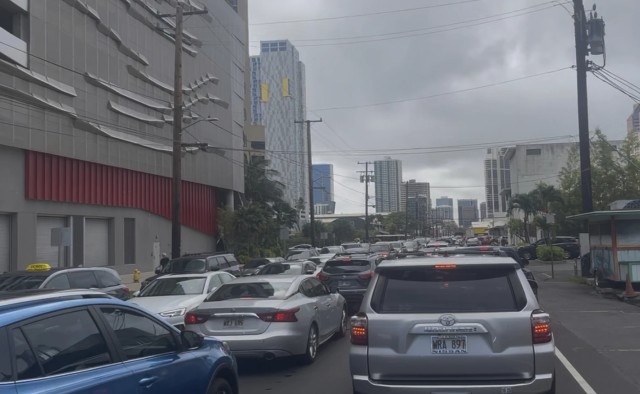
A traffic jam forms in Honolulu Tuesday, July 29, 2025 as people heed a tsunami evacuation warning that coincided with rush hour following a powerful earthquake in Russia’s far east early Wednesday.
A massive 8.8-magnitude earthquake struck off Russia’s Kamchatka Peninsula, sending ripples of concern across the Pacific. The tremor occurred early Wednesday local time, prompting tsunami warnings and advisories for Alaska, Hawaii, the U.S. West Coast, Japan, and even parts of Mexico. Authorities across these regions scrambled to alert coastal communities as the potential for dangerous waves loomed.
What Triggered the Tsunami Warnings?
The earthquake originated beneath the ocean, a key condition for tsunami generation. According to the U.S. Geological Survey, such powerful undersea quakes displace the seafloor, creating waves that can travel thousands of miles.
Dave Snider, tsunami warning coordinator at the National Tsunami Warning Center, described it as “a significant earth event” that demanded immediate attention. The force of the quake pushed water upward and outward, forming a series of fast-moving tsunami waves.
How Do Tsunamis Work?
Tsunamis are often misunderstood. They aren’t single waves but a series of powerful surges. In deep water, they can move as fast as jetliners. However, when these waves reach shallower waters near the shore, they slow down, pile up, and grow in height — increasing the risk of flooding and destruction.
Some tsunamis may cause minor sea-level changes, while others, like the 2004 Indian Ocean tsunami, result in catastrophic damage. That disaster was triggered by a 9.1 magnitude earthquake and led to over 230,000 deaths.
How Are Tsunami Warnings Issued?
Each region affected has its own alert system. In Hawaii, sirens, emergency text messages, TV and radio broadcasts notify the public. Alaska relies on weather radios, sirens, public alerts, and even door-to-door warnings in remote communities.
Social media also plays a critical role. During earlier quakes this month, cities in Alaska’s Aleutian Islands used local networks and loudspeakers to encourage evacuation to higher ground.
What To Do During a Tsunami Alert?
If you hear a tsunami warning, don't wait. Head for higher ground immediately.
In Hawaii, residents are urged to consult hazard zone maps and evacuate accordingly. The rule is to stay at least 100 feet away from marinas, rivers, and any waterway linked to the ocean. Vertical evacuation — heading to the fourth floor or higher in sturdy buildings — is also recommended if time or terrain limits escape options.
People in risk zones should grab their emergency “go bags” and move inland or uphill. Waiting could be deadly.
Understanding Tsunami Alert Levels
The U.S. National Weather Service uses a three-tier system to alert the public:
- Warning: Tsunami is imminent or occurring; evacuate coastal areas immediately.
- Advisory: Potential for strong currents and wave activity; stay out of the water and away from the shore.
- Watch: A tsunami is possible; stay alert and prepare to evacuate if needed.
How Fast Can Tsunamis Travel?
Tsunamis can reach the coast closest to the quake epicenter within minutes. In other regions, the waves may take hours. Their speed depends on ocean depth — faster in deep water, slower near shorelines.
Where Have Effects Been Seen?
So far, tsunami waves under one foot (30 cm) have been reported in Adak and Amchitka, Alaska. In Japan, small waves washed ashore in Hokkaido, Ibaraki, and Chiba. At the port of Ishinomaki, waves reached 50 cm (1.6 feet).
Hawaii expected the first waves after 7 p.m. local time. Authorities warned that even moderate waves could damage coastlines and property.
Which Areas Are Still Under Threat?
Tsunami advisories stretched from Canada’s British Columbia to Mexico’s west coast. Northern California’s Crescent City saw sirens activated as waves up to 5.7 feet were anticipated.
Oregon’s emergency department warned of waves between 1 to 3 feet reaching coastal towns by late Tuesday night. Residents were urged to stay away from beaches, harbors, and marinas.
Mexico’s navy also alerted its Pacific coastline, forecasting waves between 1 and 3.3 feet.
While this tsunami was not classified as a major disaster, it’s a reminder of the ocean’s power. Dangerous waves and currents may still pose serious risks for hours. Coastal communities are advised to remain alert and follow official updates until all advisories are lifted.