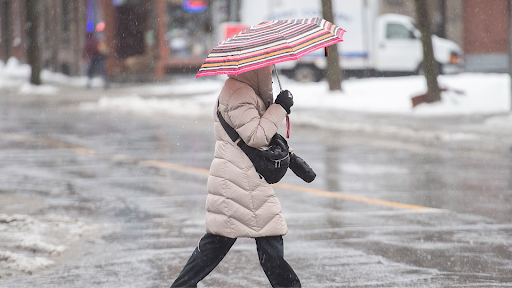
Eastern Canada faced harsh winter weather on Monday as freezing rain, snow, and strong winds moved through the region, increasing the chance of power outages across Ontario, Quebec, and the Atlantic provinces. CTV
Large parts of Eastern Canada faced difficult winter weather on Monday as freezing rain, snow, and strong winds swept across several provinces. Ontario, Quebec, and parts of Atlantic Canada dealt with icy conditions that disrupted daily life, travel, and power service. Weather experts warned that more outages could follow as conditions continue.
A meteorologist from Environment Canada said the combination of ice buildup and strong winds creates serious risks. Gerald Cheng explained that ice forms on power lines and poles, making them heavier and more likely to fail when strong winds push through the region.
“With the freezing rain, with the ice secretion on objects, on power lines, on power poles, and then the winds coming up to 90 kilometres per hour, that’s not a good combination, because that will lead to more power outages,” Cheng said.
Strong Winds Add to the Threat
Weather warnings covered wide areas on Monday. Environment Canada said wind gusts could reach up to 90 kilometres per hour in the Greater Toronto Area and around the Island of Montreal. Communities in Newfoundland and Labrador, including Bay St. George and Corner Brook, also faced strong winds.
At the same time, freezing rain continued to fall across parts of Ontario, Quebec, New Brunswick, Nova Scotia, and Prince Edward Island. Some areas also saw snowfall, adding to already slippery and unsafe conditions.
Flights Face Major Disruptions
The storm system also disrupted air travel. Delays and cancellations affected flights at Toronto Pearson International Airport and Montréal–Trudeau International Airport.
At Toronto Pearson, dozens of flights faced delays and some cancellations. Flight control officials issued notices earlier in the day, asking travellers to check flight status directly with airlines.
In Montreal, some flights experienced delays of up to three hours, while cancellations continued throughout the day. Air Canada, a major carrier at both airports, offered flexible rebooking options for affected passengers.
“Air Canada has revised its ticketing policy to make it easier for customers travelling on an affected flight to make changes to their booking without penalty, space permitting,” the airline said.
Atlantic Canada Also Impacted
Travel disruptions stretched into Atlantic Canada. Most flights at Saint John’s International Airport in Newfoundland and Labrador faced delays or cancellations. Halifax Stanfield International Airport in Nova Scotia also warned travellers to expect changes, saying crews paused aircraft operations until conditions improve.
“Due to freezing rain conditions, aircraft operations are temporarily suspended until the weather improves,” airport officials said. “Crews are actively working to resume regular working conditions as safely and quickly as possible.”
Flights between Toronto and Charlottetown, Prince Edward Island, also faced delays.
Thousands Without Power
Power outages affected tens of thousands across Ontario and Quebec. Utility officials reported more than 60,000 customers without electricity in Ontario, while Quebec saw about 21,000 outages. Crews continued restoration work, but officials warned that weather conditions could slow repairs.
Cheng urged residents in affected areas to remain cautious and prepared as cold temperatures settle in.
“We’ll still see some lake effect, but we’ll be stuck with the below freezing temperatures, and temperatures will be in the minus 10s, minus teens,” he said. “So we do have to be careful with the possible power outages that we get from this system right now so that we can be prepared for New Year’s Eve.”