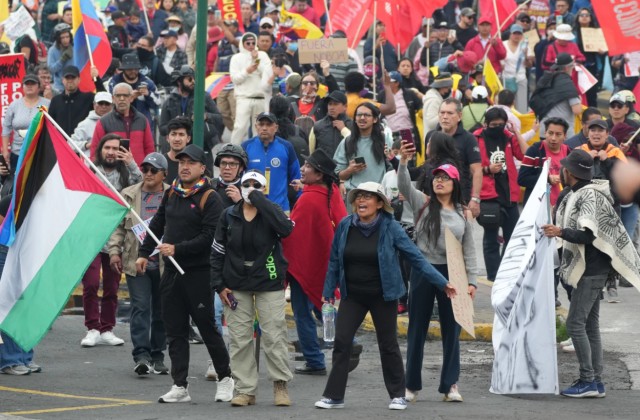
Demonstrators protest President Daniel Noboa’s government, in Quito, Ecuador, Sunday, Oct. 12, 2025.
Crowds flooded Ecuador’s capital, Quito, on Sunday, as anger over soaring fuel prices ignited another wave of nationwide protests. Demonstrators clashed with police, burned tires, and blocked key roads, intensifying public outrage against President Daniel Noboa’s government.
Protesters Demand President’s Resignation
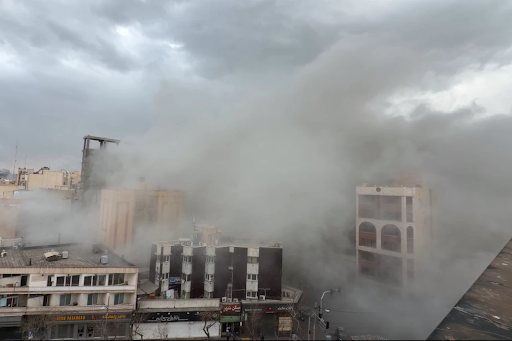
Shouting “Noboa out, out!”, protesters marched from southern Quito toward the city center. Before they could reach their destination, police on motorbikes intervened, firing tear gas to disperse the crowds. Smoke filled the streets as chaos unfolded, though no major injuries were reported.
This latest confrontation adds to a growing list of violent demonstrations that have shaken Ecuador for weeks. The unrest reflects mounting frustration with Noboa’s decision to end long-standing fuel subsidies, a move that raised diesel prices from $1.80 to $2.80 per gallon.
Indigenous Groups Lead the Nationwide Strike
The protests were organized by Ecuador’s largest Indigenous federation, which launched a nationwide strike 21 days ago. Indigenous leaders argue that the subsidy removal disproportionately impacts rural and low-income communities, especially those working in agriculture, fishing, and transportation.
For these groups, the fuel price increase threatens their livelihoods. “We are rising up against the neoliberal and hunger-inducing policies of the dictator Noboa,” said union leader Nelson Erazo, who spoke at Sunday’s rally. He accused the government of punishing the poor while protecting the interests of the wealthy.
Violence and Arrests Across the Country
Since the protests began, the demonstrations have frequently turned violent. At least one civilian has died, dozens have been injured, and more than a hundred people have been arrested. In response, Noboa declared a state of emergency in 10 provinces, restricting public gatherings and allowing security forces to intervene more forcefully.
Last week, tensions escalated dramatically when protesters hurled rocks at President Noboa’s motorcade during a regional visit. The government has since deployed thousands of police officers in riot gear across Quito to maintain control.
Protests Coincide with Day of Interculturality
The timing of Sunday’s rally carried symbolic weight. It fell on the Day of Interculturality and Plurinationality, Ecuador’s replacement for Columbus Day, which honors the country’s Indigenous heritage. For many demonstrators, the day became a reminder of their long struggle for economic and social justice.
Government Defends the Fuel Price Increase
President Noboa maintains that the subsidy removal is essential to stabilize Ecuador’s fragile economy. The government spends about $1.1 billion annually on fuel subsidies—money Noboa says is urgently needed to reduce national debt and curb fuel smuggling across the borders with Colombia and Peru.
Despite the backlash, Noboa insists his administration cannot afford to reverse the policy. He has, however, offered temporary financial bonuses to farmers and transport workers most affected by the price surge.
Refusal to Negotiate Heightens Tensions
While Noboa has toured several restive regions, he has refused to negotiate directly with the Indigenous federation leading the protests. His stance has deepened resentment among demonstrators who see the government’s approach as dismissive and authoritarian.
Analysts warn that the crisis could worsen if dialogue is not initiated soon. Ecuador’s economy remains fragile, and prolonged unrest threatens key sectors like agriculture, trade, and transportation.
A Nation on Edge
As night fell over Quito, fires still burned on several streets, symbolizing a country at a crossroads. The government’s fiscal reforms have ignited a broader debate about economic inequality, national sovereignty, and the burden of austerity.
With protests showing no sign of slowing down, Ecuador faces one of its toughest political tests in recent years — a struggle between economic necessity and social survival.