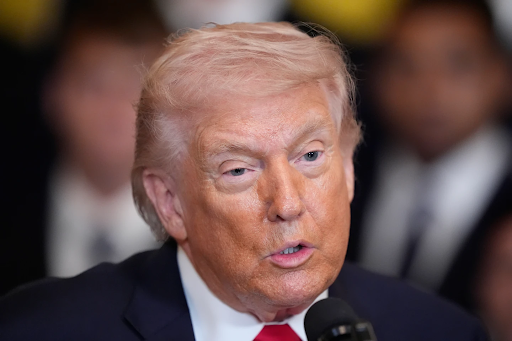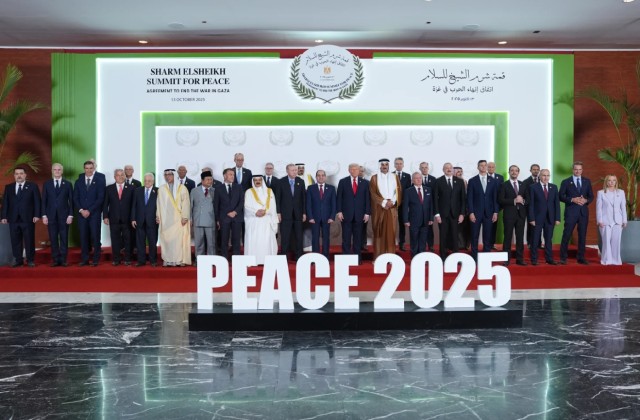
President Donald Trump and other world leaders pose for a photo during a summit to support ending the more than two-year Israel-Hamas war in Gaza after a breakthrough ceasefire deal, Monday, Oct. 13, 2025, in Sharm El Sheikh, Egypt.
Egyptian President Abdel Fattah el-Sissi has described U.S. President Donald Trump’s Middle East peace proposal as the “last chance” to bring lasting peace to the war-torn region. Speaking at a high-profile summit in Egypt’s Red Sea resort of Sharm el-Sheikh, El-Sissi urged world leaders to rally behind a two-state solution, calling it essential for Palestinian independence and regional stability.
Summit Focused on Gaza Ceasefire and Peace Vision
The summit gathered over 20 global leaders with a unified goal — to sustain the fragile ceasefire in Gaza, end the Israel-Hamas conflict, and chart a roadmap for rebuilding Palestinian territories. El-Sissi co-chaired the meeting and told Trump, “Only you can bring peace to the region.”
Trump’s proposal envisions a potential Palestinian state, but only after a long transition period in Gaza and major political reforms led by the Palestinian Authority. Israeli Prime Minister Benjamin Netanyahu, however, remains firmly opposed to full Palestinian independence.
Trump Urges a “New Era of Harmony”
In his address, Trump declared that the Middle East now has “a once-in-a-lifetime chance” to move beyond decades of hostility. He urged leaders to “declare that our future will not be ruled by the fights of generations past.”
The event also saw Trump, El-Sissi, the Qatari Emir, and Turkish President Recep Tayyip Erdogan sign a comprehensive document outlining new diplomatic and security measures. However, the details of the agreement were not made public.
Hostages Freed as Ceasefire Holds
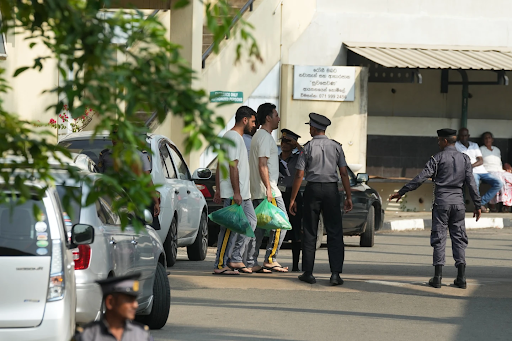
The summit followed significant progress under the ceasefire deal mediated in Qatar. Hamas released 20 remaining Israeli hostages, while Israel freed hundreds of Palestinian prisoners. Despite these steps, concerns persist about whether the peace will last or deteriorate into renewed violence.
Notably, Netanyahu did not attend the summit. Reports suggest Turkey launched a diplomatic effort to block his participation, and Iraqi officials warned they would withdraw if he appeared. His office later cited a Jewish holiday as the reason for his absence.
Egypt Pushes for “A New Page of Peace”
According to El-Sissi’s office, the summit aimed to “end the war in Gaza” and “open a new page of peace and regional stability.” The event was largely ceremonial, lasting just three hours. Leaders posed for photos with Trump before formal discussions began.
Egyptian Foreign Minister Badr Abdelatty emphasized that the success of Trump’s plan will depend on U.S. involvement, including military participation in a proposed international peacekeeping force. “We need American engagement, even deployment on the ground,” Abdelatty said.
Under the first phase of the agreement, Israeli forces began withdrawing from parts of Gaza, allowing thousands of displaced Palestinians to return. Aid organizations are preparing to deliver long-blocked humanitarian supplies into the territory.
Building Gaza’s Future
The next phase of Trump’s Middle East peace plan focuses on disarming Hamas, establishing a new transitional government in Gaza, and defining Israel’s long-term withdrawal strategy. A 15-member committee of Palestinian technocrats — approved by Israel and unaffiliated with any political faction — will manage Gaza’s daily affairs under supervision from a proposed “Board of Peace.”
The World Bank estimates that rebuilding Gaza will cost around $53 billion. Egypt will host a reconstruction conference in November to mobilize international funding.
Global Support and Challenges Ahead
Several nations pledged support for the initiative. Britain announced £20 million ($27 million) to improve water and sanitation in Gaza and will host a conference on recovery efforts. Jordan and Egypt will jointly train the new Palestinian security force, while Turkey, which has long hosted Hamas leaders, played a critical role in brokering the ceasefire.
Germany expressed support for reconstruction but voiced concern over Israel’s handling of the war. Iran — a key Hamas ally — was notably absent, signaling its waning regional influence following recent conflicts with Israel.
“The World Is Watching”
Despite cautious optimism, many challenges lie ahead. Disarming Hamas, establishing governance in Gaza, and maintaining Israeli cooperation remain uncertain.
As El-Sissi concluded, “The world is watching. This may be our final opportunity to turn the page and make peace a reality.”