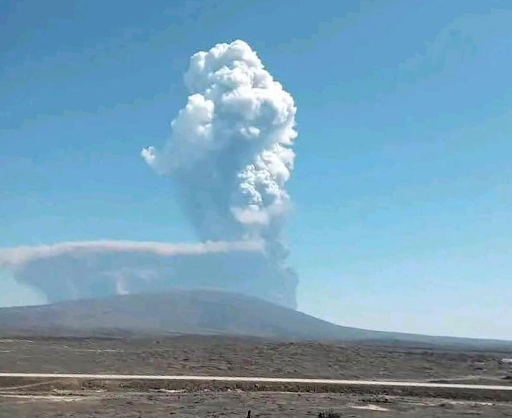
In this image from the Afar Government Communication Bureau, ash rises from the Hayli Gubbi volcano during its first recorded eruption on November 23, 2025. AP Photo
A volcano in Ethiopia’s north-eastern Afar region erupted on Sunday for the first time in nearly 12,000 years. The Hayli Gubbi volcano sent a massive column of smoke high into the sky. The ash rose about 14 kilometres and drifted across the Red Sea toward Yemen and Oman. The sudden eruption caught many residents by surprise.
Local communities face serious challenges
The volcano sits about 500 miles north-east of Addis Ababa near the Eritrean border. Local official Mohammed Seid said the blast caused no injuries. He worries, however, about the impact on people who depend on livestock for their income. He says ash covered several villages, leaving animals with little grass to eat. Many families fear long-term losses if grazing land stays buried under ash.
Seid added that no one in the region ever recorded an eruption from Hayli Gubbi. The community had no memory of activity from the volcano and now faces uncertainty about the days ahead.
Ash travels far beyond Ethiopia
The volcano rises about 500 metres above the surrounding land and sits within the Rift Valley. This area is known for intense geological activity because of shifting tectonic plates. The eruption sent ash clouds over several countries. Weather agencies reported ash drifting toward Yemen, Oman, India and northern Pakistan. These clouds could affect air travel and visibility in some regions.
Witnesses describe loud blast
Residents living near the site said they heard a loud sound before the eruption. One man, Ahmed Abdela, said he felt a strong shock wave. He described it as feeling like a sudden explosion followed by smoke and ash. Many people in the area said they had never heard anything like it.
Videos posted online show a thick column of white smoke rising from the volcano. Experts say the footage matches the early stages of a major eruption, though the images have not been fully verified.
Scientists confirm historic event
The Smithsonian Institution’s Global Volcanism Program says Hayli Gubbi has no record of any eruption during the Holocene, the period that began about 12,000 years ago. Volcanologist Simon Carn also confirmed the absence of any known eruption during that time. The event marks a significant moment for researchers studying the Rift Valley, which contains many active and dormant volcanoes.
Scientists continue to watch the area closely. They say the eruption highlights how unpredictable the region’s geological activity can be. Locals hope the ash will settle soon so they can return to normal life.