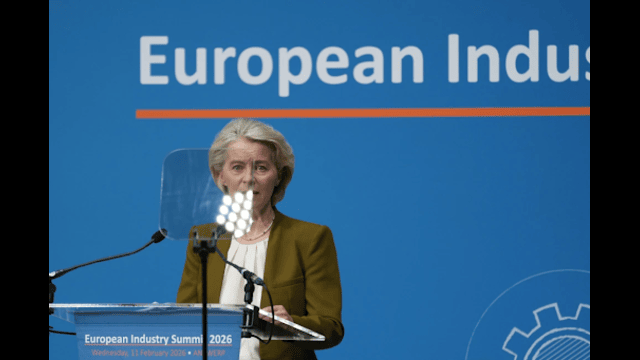
European Commission President Ursula von der Leyen speaks during the European Industry Summit in Antwerp, Belgium, Wednesday, Feb. 11, 2026.
European Union leaders gathered Thursday at a historic Belgian castle as external pressures reshape the bloc’s global outlook.
The EU leaders meeting comes at a moment of rising geopolitical strain, driven by U.S. policy shifts, Chinese trade tactics, and Russian hybrid threats.
Together, these challenges are forcing Europe to reconsider how it defends its economy, industry, and diplomatic influence.
Belgian Prime Minister Bart De Wever captured the mood ahead of the talks.
He said Europe knows change is necessary but often struggles to act decisively.
That sense of urgency now defines the broader debate about the EU’s future direction.
A Divided Vision for Europe’s Next Steps
The EU leaders meeting is meant to shape proposals for a larger summit in late March.
However, sharp divisions have emerged over how the bloc should respond to mounting global pressure.
These differences are becoming increasingly visible as leaders debate trade, defense, and economic reform.
German Chancellor Friedrich Merz and Italian Prime Minister Giorgia Meloni are leading a pro-reform group.
They argue Europe must deregulate its economy and rebuild stronger ties with Washington.
They also support expanding trade agreements, including recent deals with South American Mercosur nations.
Merz has been especially vocal about reducing regulatory burdens.
He believes deregulation is essential for restoring European competitiveness in a fast-changing global economy.
France Pushes for European Preference
France is taking a different stance at the EU leaders meeting.
President Emmanuel Macron is urging stronger protection for European industries across key sectors.
He argues that Europe must prioritize its own companies in defense, clean technology, steel, and automotive manufacturing.
Macron says global competition is no longer fair or rules-based.
He points to China and the United States as examples of aggressive industrial protection.
Without similar safeguards, he warns, European firms risk being pushed aside.
A major dispute centers on defense spending.
Macron wants EU defense funds directed mainly to European arms manufacturers.
Germany and Italy favor a more open approach, including foreign suppliers alongside EU companies.
Trade, Tariffs, and Financial Firepower
Trade security is another core issue shaping the EU leaders meeting.
Trump’s wave of tariffs and China’s limits on critical mineral exports have unsettled global markets.
EU leaders are now discussing new financial tools to protect the bloc from future shocks.
Macron has revived calls for joint EU borrowing.
He describes these ideas as “Eurobonds for the future.”
Such instruments, he argues, could reduce dependence on the U.S. dollar and strengthen Europe’s autonomy.
Germany and Italy remain cautious on shared debt.
They are also stepping back from the broad economic overhaul proposed by former ECB chief Mario Draghi.
Draghi has called for deeper investment, infrastructure spending, and regulatory simplification across the bloc.
Economic Strength as Strategic Power
European Commission President Ursula von der Leyen echoed calls for economic resilience.
Speaking this week, she stressed that economic strength underpins Europe’s global influence.
Her message aligns closely with Germany’s focus on competitiveness and market reform.
Public opinion appears to support stronger EU action.
A recent Eurobarometer poll shows growing demand for unified leadership.
Citizens cite security threats, economic uncertainty, and climate instability as key concerns.
As the EU leaders meeting continues, expectations are rising.
Analysts say the moment offers a rare chance to act decisively.
Whether leaders can bridge divisions may determine Europe’s standing in an increasingly competitive world.