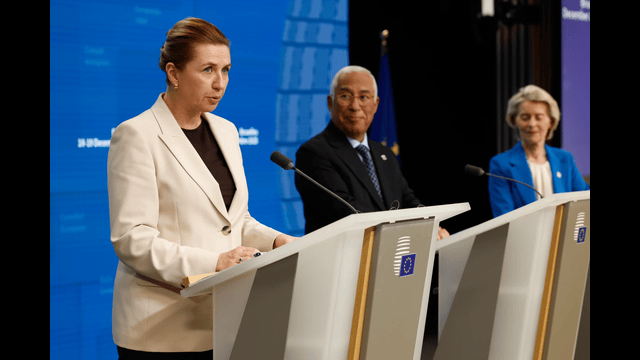
Denmark’s Prime Minister addresses a media conference at the EU summit in Brussels, Friday, December 19, 2025.
European Union leaders have agreed to provide a €90 billion loan to Ukraine to support its military and economy. The decision follows intense talks in Brussels after plans to use frozen Russian assets collapsed over legal concerns. The funding is aimed at keeping Ukraine financially stable through 2026 and 2027.
Ukraine’s Urgent Funding Need
After nearly four years of war, Ukraine faces severe financial strain. The International Monetary Fund estimates Kyiv will need €137 billion across 2026 and 2027. Without urgent support, officials warned the government could face bankruptcy by spring.
The loan gives Ukraine immediate breathing space as the conflict continues and reconstruction costs rise.
Why Russian Assets Were Not Used
EU leaders initially planned to fund Ukraine using profits from €210 billion in frozen Russian assets held across Europe. Most of those assets sit in Belgium, managed by Euroclear, a major financial clearing house.
Belgium raised strong objections. Prime Minister Bart De Wever warned the plan carried serious legal risks. He said it could trigger Russian retaliation and damage financial stability.
Belgium’s concerns intensified after Russia’s central bank filed a lawsuit against Euroclear last week. The case aims to block any loan to Ukraine using frozen Russian funds.
Capital Markets Chosen as Safer Route
As talks dragged late into Thursday night, leaders shifted strategy. They agreed to borrow on capital markets instead of using Russian assets directly.
EU Council President António Costa confirmed the deal publicly. He said the bloc approved €90 billion in support for Ukraine for 2026 and 2027.
Costa added that Europe delivered on its commitment despite internal divisions.
Opposition Without a Veto
Not all EU members supported the loan. Hungary, Slovakia, and the Czech Republic opposed the package politically. However, they agreed not to block the decision.
In return, those countries received assurances they would be protected from any financial consequences.
Hungarian Prime Minister Viktor Orbán criticized the move sharply. He said giving money meant prolonging war. He also called the Russian asset plan a “dead end.”
Strong Support From Major EU Powers
France and Germany strongly backed the loan decision. French President Emmanuel Macron called market borrowing the most practical solution. He said it ensured stability while avoiding legal uncertainty.
German Chancellor Friedrich Merz confirmed the loan would carry zero interest. He said the funds would cover Ukraine’s military and budget needs for two years.
Merz stressed that frozen Russian assets would remain blocked. He said they could eventually be used if Russia refuses to pay reparations.
Reparations Still on the Table
Ukrainian President Volodymyr Zelenskyy has estimated war reparations from Russia could exceed €600 billion. Germany signaled that seized assets may later help repay the EU loan.
Merz said any future use of Russian assets would follow international law. The EU, he added, still reserves the right to act.
Pressure for a Fast Decision
Zelenskyy traveled to Brussels to push for urgent action. He warned that delays could destabilize Ukraine’s economy early next year.
The summit unfolded amid protests by farmers opposing a proposed EU trade deal with South American countries. Despite unrest, leaders pressed ahead.
Polish Prime Minister Donald Tusk framed the choice bluntly. He said Europe must send “money today or blood tomorrow.”
Belgium Defends Legal Principles
Belgium stood firm even after pressure from other leaders. De Wever said the rejected plan lacked clarity and legal certainty.
He argued that forcing the issue could undermine global trust in European law. Belgium, he said, protected the rule-based financial system.
At the same time, he stressed Europe’s political unity with Ukraine.
What the Decision Means
The €90 billion EU loan to Ukraine secures short-term stability but leaves long-term funding questions open. The failure to unlock Russian assets highlights deep legal and political divisions.
Still, the deal sends a clear signal. The European Union remains committed to backing Ukraine, even under pressure.