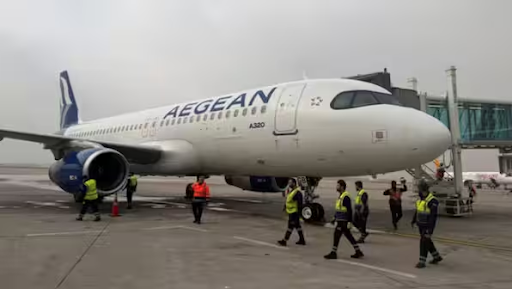
A flight operated by Greece’s Aegean Airlines touched down in the Iraqi capital on Tuesday. (X)
After more than three decades of absence, a European airline has once again landed in Baghdad. On Tuesday, a flight operated by Greece’s Aegean Airlines touched down at Baghdad International Airport, marking the first arrival by a European Union carrier in 35 years.
Iraq’s transport ministry described the landing as a symbolic breakthrough. Officials said it signalled Iraq’s return to Europe’s aviation network and reflected renewed confidence in the country’s recovery.
For many Iraqis, the moment represented more than a flight. It marked a cautious reopening to the world after years of conflict, isolation, and uncertainty.
A long absence from European air routes
European airlines stopped flying to Baghdad in the early 1990s. The withdrawal followed Iraq’s invasion of Kuwait under former ruler Saddam Hussein.
That move triggered the Gulf War and brought sweeping international sanctions. Security conditions deteriorated rapidly, making commercial flights unsafe and economically unviable.
Air travel to Iraq became heavily restricted. European carriers gradually suspended operations, and Baghdad disappeared from their route maps.
Instability kept skies closed for decades
Hopes of a quick return faded even after Saddam Hussein was removed in the 2003 US-led invasion. Instead of stability, Iraq entered a prolonged period of violence.
Civil conflict, sectarian tensions, and insurgent attacks spread across the country. Armed jihadist groups emerged, and bombings became frequent.
Airport security remained a serious concern. For European airlines, the risks outweighed any commercial incentive to resume direct flights.
As a result, bans and informal restrictions stayed in place for years. Baghdad remained largely cut off from European aviation.
Signs of stability bring cautious optimism
That long pause is now slowly ending. In recent years, Iraq has shown signs of improved security, especially in major cities.
The government has worked to rebuild infrastructure and strengthen airport safety measures. Officials have also pushed diplomatic and economic reforms to restore international trust.
The return of a European airline is being seen as a vote of confidence. It suggests that Iraq’s stability, while fragile, has reached a level acceptable for commercial operations.
New route links Baghdad and Athens
Under the new arrangement, Aegean Airlines will operate two weekly flights between Baghdad and Athens. The Iraqi transport ministry said more services could be added if demand grows.
The route is part of a broader effort to reconnect Iraq with Europe. Officials hope improved air links will boost tourism, trade, and business travel.
It also supports Iraq’s goal of attracting foreign investment to an economy weakened by decades of war and sanctions.
Erbil paved the way
Aegean Airlines had already taken an earlier step into Iraq. The carrier began flying to Erbil, the capital of the Kurdistan region, earlier this year.
Erbil has long promoted itself as safer and more stable than other parts of the country. It has served as a testing ground for renewed international engagement.
The successful Erbil operations helped build confidence for expanding services to Baghdad.
A symbolic step, not a finish line
While the landing is historic, challenges remain. Security concerns have not vanished entirely, and airlines will continue to monitor conditions closely.
Still, the return of a European carrier carries strong symbolic weight. It reflects Iraq’s determination to move beyond isolation and rejoin global networks.
For Baghdad, the sound of a European aircraft touching down again signals a slow but meaningful step toward normalcy.