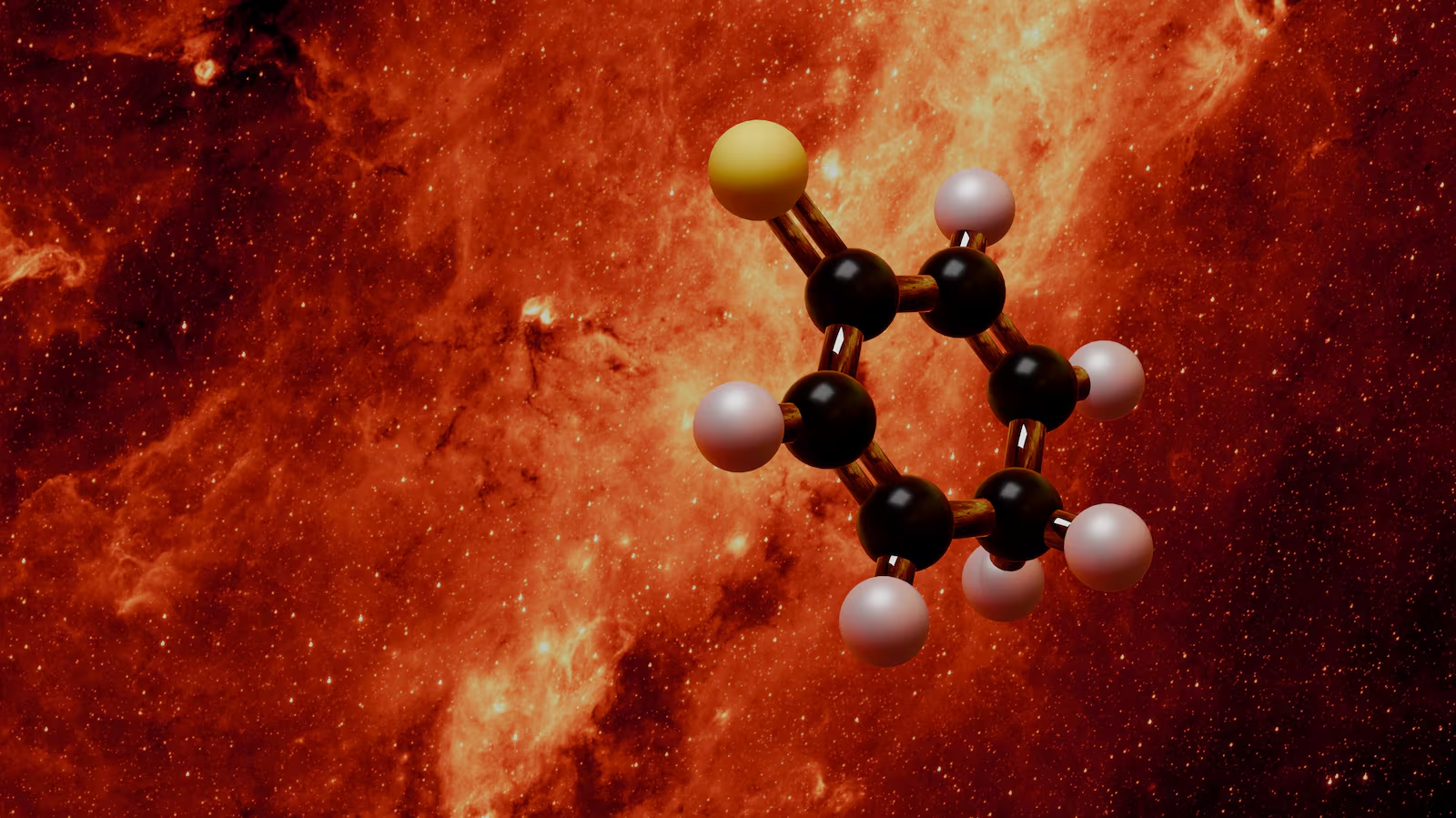
An illustration shows a newly identified 13-atom molecule that contains sulfur, marking the first time scientists have found this type of compound in interstellar space. CNN
Scientists have identified the largest organic molecule containing sulfur ever found in interstellar space, a discovery that may help explain how the basic ingredients of life formed long before planets like Earth existed.
Researchers describe the finding as a missing piece in the story of how life-related chemistry developed in space and later reached planets through comets and meteorites.
Why Sulfur Matters
Sulfur plays a vital role in life on Earth. It forms part of amino acids, proteins, and enzymes that keep cells working. Scientists know sulfur ranks as one of the most common elements in the universe, yet they have struggled for years to explain why large sulfur-based molecules rarely appear in deep space.
“Sulfur came to Earth from space long, long ago,” said Mitsunori Araki, a scientist at the Max Planck Institute for Extraterrestrial Physics in Germany and lead author of the study.
“However, we have only found a very limited amount of sulfur-bearing molecules in space, which is strange. It should exist in huge amounts, but it’s very difficult to find.”
Filling a Long-Standing Gap
In the past, scientists detected sulfur molecules in comets and meteorites, but they rarely found large ones floating between stars. Some researchers suggested sulfur hides inside cosmic ice, making it hard to detect.
The newly discovered molecule changes that picture. Made of 13 atoms, it surpasses all previously known sulfur-containing molecules found in interstellar space.
“This is the largest sulfur-bearing molecule ever found in space, at 13 atoms,” Araki said. “Before this one, the largest only had nine atoms.”
The molecule, known as 2,5-cyclohexadiene-1-thione, contains sulfur, carbon, and hydrogen. Scientists believe finding larger molecules like this helps bridge the gap between simple space chemistry and the complex building blocks of life seen in meteorites.
Found in a Stellar Nursery
Researchers detected the molecule inside a cold, dense cloud of gas and dust called G+0.693–0.027, located about 27,000 light years from Earth near the centre of the Milky Way.
These molecular clouds act as stellar nurseries, where new stars form as gravity pulls material together. According to Valerio Lattanzi, a co-author of the study, the materials inside these clouds eventually become part of planets.
“The ingredients that are embedded in the molecular cloud will be transferred to the planets,” he said.
How Scientists Found It
The research team recreated the molecule in a laboratory by applying an electric charge to thiophenol, a sulfur-rich liquid. They then recorded its unique radio signal and compared it with telescope data collected in Spain.
This careful match confirmed the molecule’s presence in space and suggested that even larger sulfur-based molecules may exist elsewhere.
What It Means for Life Beyond Earth
Outside experts say the discovery strengthens the idea that life’s building blocks may form widely across the galaxy.
Kate Freeman, a geosciences professor at Penn State University, called the work “an exciting detective story” that helps explain how complex molecules may reach planets.
Sara Russell, a planetary scientist in London, added that the discovery suggests life-friendly chemistry could be common in space, not unique to Earth.
A Bigger Picture Emerging
Scientists once believed harsh space conditions destroyed complex molecules. Now, discoveries like this show space chemistry is far richer and more resilient than expected.
Researchers say this sulfur-rich molecule marks another step toward understanding how life may have started—and where it might exist elsewhere in the universe.