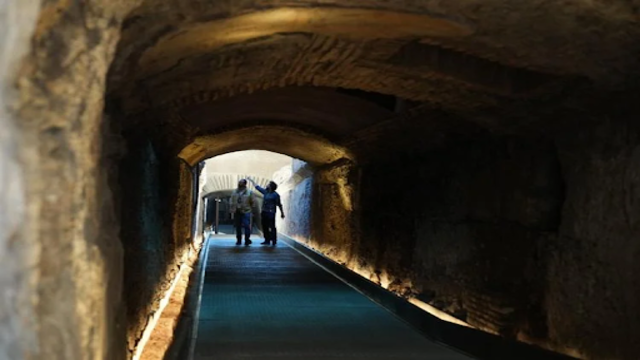
Workers walk in the so-called ‘Passage of Emperor Commodus’, a newly restored tunnel ancient Roman emperors would use to enter the Colosseum unseen and protected, that will open to visitors at the end of the month, in Rome, Oct. 8, 2025. (AP Photo)
For the first time in nearly two millennia, visitors to Rome’s iconic Colosseum can walk the same hidden passage once reserved for emperors. The newly restored “Commodus Passage,” an underground imperial corridor long sealed from public view, will officially open on October 27.
Archaeologists describe the opening as a remarkable moment in the preservation of one of the world’s greatest monuments. The corridor, dating back to the 2nd century A.D., once allowed emperors to enter the amphitheater unseen and safely, leading directly to their exclusive viewing box overlooking the games.
A Hidden Path of Power
The passage is named after Emperor Commodus, who ruled from 180 to 192 A.D. and became infamous for his fascination with gladiatorial combat. Popularized in modern culture by Ridley Scott’s Gladiator, Commodus was known to personally participate in arena fights.
Historical records reveal that an assassination attempt was once made on him while he was walking through this very corridor. The passage, first discovered in the early 1800s, had remained inaccessible to the public until now.
At the entrance, archaeologists unearthed intricate decorative fragments that hint at the Colosseum’s vibrant past. Among them were carvings and reliefs depicting boar hunts, bear fights, and acrobatic feats—artistic previews of the spectacles that unfolded in the arena above.
A view of the entrance, center, of the so-called ‘Passage of Emperor Commodus’. (AP Photo)
A Journey Through Time
The corridor, built in an ‘S’ shape, stretches beyond the main structure of the Colosseum, though its exact end point is still a mystery. Restoration architect Barbara Nazzaro, who led the project, said the space has been carefully revived to allow visitors to “experience what it felt like to be an emperor entering the arena.”
“With imagination and the help of virtual reconstructions, people can now visualize the original colors, marble walls, and frescoed ceilings that once dazzled Rome’s elite,” she said.
The restoration project, carried out between October 2024 and September 2025, involved extensive conservation of stuccoes and plasters, as well as the creation of a new raised walkway for visitors.
A view of the so-called ‘Passage of Emperor Commodus’. (AP Photo)
Modern Light on Ancient Stone
A newly installed lighting system now mimics the natural sunlight that once filtered through small openings in the vaulted ceiling. Digital projections offer a virtual glimpse of how the corridor looked during its imperial glory, blending ancient history with modern technology.
Archaeologists say the opening represents not just a physical restoration but also a symbolic one—reconnecting modern Rome with its imperial heritage. Visitors can now explore a route that, until recently, existed only in legend and scholarly research.
What Lies Ahead
Plans are already in place for a second phase of restoration, expected to begin in early 2026. That project will focus on the section of the tunnel extending beyond the Colosseum’s outer wall, offering the potential to uncover even more of the hidden infrastructure that once served the Roman elite.
For now, the unveiling of the Commodus Passage marks a powerful reminder of Rome’s enduring ability to bridge past and present—allowing today’s visitors to walk, quite literally, in the footsteps of emperors.